Uncategorized

A boy’s prayer.

I am passing this prayer request on for a family in my homeschool group.  Their son had a growth on his toe removed earlier this year and it grew back requiring a second surgery which their insurance wasn’t going to cover.   Here is her latest email:

I wanted to give you all an update on Joshua.  I am still in awe at the generosity of his Doctor for not only doing the surgery for free up arraigning the surgery center and the anesthesiologist for free also.  We made cookies and Joshua made him a thank you card but I have been feeling that I needed to do more.  Yesterday Joshua went to have his stitches taken out and I truly believe God let me know what I was supposed to do for him.  I am now asking for all of your help in this.  Joshua told his Dr. “Happy Fathers Day”.  His Dr. replies as of now I am only father to two dogs he then said that sometimes it is hard for some woman to have a baby. He then went on to say that he and his wife would like nothing more then to have a baby.  Joshua then said I will pray for you every day so you can have a baby.  I saw how touched he was by this and said if it happens in the next couple of months that it will be because of you Joshua.  I realize at this point this is what I can do for him.  I ask you all for your help in this.  I know how powerful the prayers in this group are.  Could you all please help me in this a say a prayer for Dr. Jason S. and his wife so that they may know the joys of parenthood.

Thank you and God Bless- 
Sarah
I hope you will join me in praying for this special request.


Uncategorized

Menu Planning Part 3

From Template to Table

In my last two menu planning articles I have rambled through the basics behind menu planning and put together a template and some concepts to keep in mind when planning out the week’s menus.   This article builds on those ideas and goes from the menu template to the shopping list to the table.

Every family has their favorite meals and dishes, some families deal with allergies and others have strong likes or dislikes.  Additionally culture influences what the menu looks like.  Do you enjoy curries or is pork sausage a favorite?  When I first started seriously menu planning I found that I wanted to make some changes in my family’s diet, mostly looking for healthier choices.  We like meat load, steak, burgers… basically a lot of high-fat red-meat heavy meals.  We also struggle with getting in a good number of vegetable and fruit choices unless I am menu planning.  It is very tempting for me to plan the dinner menu and ad lib the rest but life works better and our diets are healthier if I avoid this temptation.  My menu template is just that… mine.  I find it works well for my family but your might be completely different.  So if you find this doesn’t work for you or you feel it isn’t healthy enough please change it to your heart’s desire.  But, as an example I will use my menu template.

Several years ago I took the time to ask each family member what their favorite meals where.  Lasagna, taco casserole, salmon, chili, lemon-ginger chicken, chicken Budapest, pesto and pasta, steak… the list went on.  I found that we were short on fish and vegetarian/legume dishes and heavy on red meat.  I took the meals my family loves and put them into a database that would generate up to 52 nights of meal options.  I added in several “try a new fish” and “try a new veggie” nights.  This, I reasoned, would allow me to introduce new options and keep those that my family liked.  Thus was born my first incarnation of my “menu planner” software solution.

Making your family’s favorite meal list:
This is going to be unique to every family.  To create mine I sat down and wrote out those things I knew would be on the list and then asked everyone to tell me what they liked too.  Some items are a universal hit, some are liked by most the family, some are beloved by one or two of us.  I go back and forth on the number of menu options you need.  Part of me thinks it is fun to have a variety of meals that go through a long cycle, other times I think some family members would be happy with the same thing every week (Tuesday is Taco night, Friday tuna casserole and Saturday is pizza for example).   Right now I am settled on a four week rotating cycle with spots for new items to try three times.  

Trying new things is also a personal option.  Some people love to cook and can cook well, they either follow recipes meticulously or they are able to just be creative and turn our brilliant meals. Others struggle in this area.  Cooking is a skill, good cooking is a matter of practice and great cooking is an art.  If you are unsure of your cooking skills don’t start out by being really creative.  Start with some basic recipes that your family likes and master those then expand your cooking horizon if that appeals to you.  If you start out with seven simple healthy meals that you take the time to master you and your family will be more happy with the results than if you start out trying to do twenty-eight complicate menus and keep adding in new things in an attempt to find something better.

My parents taught me this quite by accident.  My mother is a really great woman, but her skills in the kitchen are underdeveloped.  I remember when I was young she would go through magazines and clip new recipes, go shopping with her neat list and have the very best of intentions to spend as little as possible.  The sad fact was that she didn’t like to cook much.  She viewed it as an awful chore and would try to speed through it as fast as she could.  If an onion needed diced it would be cut into huge chunks (faster that way), if something needed roasted it was just a little bit higher temperature (just add 50 degrees) than the recipe called for (it would be faster) if something had to simmer it would be boiled for a little while (yes, that would be a speed thing too).  The stove top seemed to have two temperatures off and high.  Spices and seasoning where measured quickly, added  in all at once and stired for as brief a time possible — except for vegetables which need to be boiled to mushiness.  No one really liked to eat mom’s meals.  So her feedback was my father dutifully gulping it down and the children (me included, sorry mom) whining about how the food sucked.   No wonder she dreaded the whole thing and was greatful when we got old enough to cook for ourselves.

My dad is a very good cook.  It started out that for some reason he took a liking to Chinese cooking.  He had a friend come over to the house one Saturday and teach him how to make some of his favorite dishes. Then dad got a couple cookbooks and started practicing the dishes that sounded best to him.  He was very careful in his prep-work, everything was cooked at the proper temperature in the manner the recipe called for.  He would purchase quality ingredients and measure them very carefully.   Everyone loved Chinese night, mom loved it (good food and she didn’t have to cook, what wasn’t to love?) and the happy children chowed down and proclaimed it all wonderful.  Dad learned to cook.  He started with something he liked, asked someone with more experience to help him get started then practiced.  He also followed the recipes to the letter, used the proper techniques and started with quality ingredients.  It became something he enjoys still.

So, don’t stress if you feel your cooking isn’t superb right now.  Good cooking can be learned.  Start with easy basics, follow your recipes to the letter, maybe take a cooking class or two.  Enjoy the process.  Don’t rush your cooking and realize that even if the family grumbles and moans at the moment there will come I time when your skills improve and you and your family will be delighted with the results.  Cooking is a small thing and can be a chore, but as with so many mundane tasks,  if done with love cooking becomes a pleasant service.  Take care to do those little things that make the difference, even if the difference doesn’t seem large, the people who serve in your own home are the most important in the world.

Novice cook or full blown chief extraordinaire there will still be a finite list of meals that you will pick for your family.  You decide how many weeks you rotate your list, you might find that you have some absolute favorites that show up more frequently than others or you might have two or three weeks of things that loop.

I have 28 favorite meals with three “new meal” nights which replace one of the favorites.   I like to start with dinner’s main course.  We have three nights where I have meat, one chicken nights, two nights with fish, and one legume night. If I am being smart I check the local sales fliers, what is in season locally and my freezer to help me plan what to eat.  Using my family’s favorite meal list I populate the main dish for each dinner.  Once this is done I can plan the side dishes.   I try to keep in mind that little poem:

Something soft and something crisp
Should always go together,
And something hot with something cold
No matter what the weather;
Something bland needs the complement
Of something with tang and nip.
Follow these rules and all your meals
Will have taste appeal and zip.

After the dinner options I plan out the lunches, breakfasts and then snacks.  Then I pull the recipes out, multiplying the servings as I need to  so I know what to purchase.  For instance if a recipe calls for an 8 oz can of tomato sauce for four servings I am going basically double it.  I break the list into staples and produce.  I will pick up all the non-perishables in one trip which leaves me to pick up produce, meat and dairy in smaller shopping trips to help assure freshness. 
 

Uncategorized

Plan for the day:

Today’s lucky room of the day is my bedroom.
I will reorganise one small area.  Today is going to be a shelf in the office.

I have two articles I am working on for here.

We are going to make bread and sew a little.

Good day ahead, I just wish the weather was nicer.

Uncategorized

It’s Memorial Day

We remember all those who’ve fallen.

Among them:
Cpl. Bobby P. Warns II  who was killed in action in Iraq on Nov. 8th, 2004. He left behind his pregnant girlfriend, Erin, and his daughter Payton Elizabeth Robert Warns who was born May 5th, 2005.  While I don’t know this family when I came upon this video, it is such a touching tribute, I felt it well worth sharing on this day set aside to remember those who gave everything in service of our country.

We salute those who serve.

Thank you.

rants · Uncategorized

Defining art

A couple of stories have attracted my attention the past few weeks.  One was that poor, silly woman from Yale who apparently (or not) tried to impregnate herself as often as possible, then took some sort of herbal abortificant (not really) and filmed herself aborting (or menstruating) and then wanted to combine that with plastic wrap and something or other and this was supposed to be displayed as a medium for inciting conversation about the relationship between the female body esthetically and functionally or something like that.   Because women and reproduction is such a very neglected discussion point in our society.   She succeeded in grossing out a lot of people and really getting Yale very up-tight.  But is that “art”?

Then there is some fellow who got a dog off the street (or hired some kids to find one) then took it to an art gallery where it was tied up and allowed to die (or not) and the artist laid out the cryptic message “you are what you read” in dog biscuits were the dog died (or not – the stories keep changing to fast to keep up).  Maybe we are supposed to see ourselves as the dog biscuits? Or maybe this is some commentary on animal cruelty and the absolute irony of modern society. A lot of people got upset and it looks like the “artist” is going to perform his art again… because it is art.  Isn’t it?

Really, if either of the above things count as art I must be completely mad.  I love good art.  I spent a lot of time in the BMFA in college and I loved my art history classes.  I love a lot of the new art coming out, the classical revival work is really exciting to me.   I love music and poetry and theater and visual art in all its many forms.  Art has shaped and enlighten my thoughts and enriched my life in innumerable ways.  That is the main reason that I really wish that the “art” community would stop treating this juvenile, sadistic, duncical, low-class, gutter obsessed, attention whoring,  offensive, drek as art.  It is not.

It is not art in the same way my child throwing a temper tantrum is not negotiation.  Art, as it is arguably defined in some college classes I have attended, is designed to make you think. Maybe something that challenges the viewer.  (At that point it usually collapses into verbal garbage about the deep, challenging, thought provoking thing that is the insulting, argumentative and usually down right disgusting excuse for modern de-constructed art).  These types of exhibitions can at best be called performances.  What they actually seem to be is rather pathetic screaming fits thrust into what should be the rational discourse of public ideas.  When what you do is so offensive that it ceases to be thought provoking and becomes merely provoking, it ceases to be about the ideas and becomes about the “artist”.

What these forms of performance art most represent is a break down of discourse in the public sphere.  Everyone has an opinion and every opinion must be expressed but the only opinions that count are the ones that get 15-minutes of fame.  They make the news, hit the top of Goggle and technorati, they scream really loudly for a few seconds and then are gone, replaced by then next wacko with an opinion that they want to shock the world into thinking about. Instant attention doesn’t equal fame, and even fame doesn’t equal any sort of gravitias, it just means that you are the one in the spotlight this second.   These pathetic attention stunts excused with the misbegotten title of art are more like those silly game shows where the audience dresses up in outrageous costumes so the camera will pan over them for a moment than they are any type of serious discourse on important topics.     They don’t even serve their stated purpose of getting people to discuss the ideas they are supposed to be about all they do is create offense and outrage usually directed towards the artist and/or the institution they are sponsored by.

In normal society when someone starts raving and offends those they are with they soon find themselves excluded and unwelcome.  The same should happen to this crass form of expression called performance art.  We, as a society, have to refuse to call this art and start calling it what it is.  It might be self-absorbed, pathetic, disgusting attention whoring.  It might be cruel, sadistic, attention-whoring, but it isn’t art.

Homemaking · Mary Mary and Martha · My world · Uncategorized

Menu planning

One of my old stand-bys is my 1950, Betty Crocker Cookbook, 1st edition.  (Now, I know that Betty Crocker wasn’t a real person.. but I still find a bit of humor in thinking of the cookbook as “Betty” — my grandmother is another Betty so maybe this adds to the charm, but either way I hope you can bare my bit of madness here as I refer to her as a real person.) My tattered red friend is not the reprint, but the original with all its sexist little comments and admonitions on being an active and productive homemaker.   It is filled with good advice about work habits, entertaining, recipe short-cuts, meal planning and nutrition.  

One thing I find most useful is this book assumes nothing.  It starts from the idea that the reader is a complete homemaking ingenue and goes from there.   So it actually covers things that one would have assumed that a young woman growing up in the 30s and 40s would probably know.  Betty Crocker advises that the homemaker plan menus at least one week at a time and better to do two weeks or even a month at once, to shop only once or twice a week.  The second shopping trip should be for perishables.   She suggests keeping a “well stocked emergency shelf”  to deal with those unexpected guests or inordinately hectic days where the lady of the house is too busy for shopping and cooking.  All sensible and good advice and I think that the starting point is spot on,  nutrition.

Now, Betty Crocker, 1950, is a little behind on the scientific discoveries of today.  But, Betty and her counterparts knew full well that little Judy and Johny needed nutritionally balanced meals so they could grow up and become useful and happy adults.  In the 1950’s cookbook there is no fudging on who is responsible for seeing that happens. Mom is the “go-to” person for healthy meals, clean and tastefully decorated homes and family entertainment.  The world has changed a great deal.  The young homemaker of 1950 was held to a somewhat different set of standards but, she also wasn’t facing some of the same temptations and bad habits that we face.  In the chapter on short-cuts she mentions that in larger cities there are places where you can pick up whole meals and take them home as a modern marvel, almost experimental in their novelty.   It was 5 years before Ray Kroc would open his first McDonald’s, packaged food was almost non-existent,  the first Swanson TV dinner wouldn’t hit the store shelf for four more years.  So, while the details of what was then considered a healthy meal are dated, the principles and the application of planning and preparing are, if anything, even more relevant to today than when they were written. 

Betty Crocker quotes the “Smart Homemaker” saying, “My meals are more nutritious since I’ve been planning them ahead.  I check in advance the basic foods and the daily needs of my family.”   To get a good idea of what those basic needs are I use the Harvard Healthy Eating Pyramid.  It took more tweaking than I would have liked to figure out how to translate the pyramid into meals.  For some reason the geniuses at Harvard figured that spelling things out in “servings” wasn’t how people really eat.  To help out on this and to get a bit of a different angle I also looked at The UMIM Healing Foods Pyramid  which actually turned out to be more practical.  I finally got it worked out and could create a template for menus.  The raw template has “slots” for menu items that I can drop items from the different categories into to create meals.   

 I know there are many different food plans out there, with different claims to what is the most healthy way to eat.  And really, I am not going to sort that out or make any judgement for anyone else on that. Find what works for you according to your family’s tastes, your beliefs and culture and what makes sense to you.  What makes sense to me the two pyramids married with the idea of local and seasonal food and sustainable agricultural practices.   In practice we use too much red meat, I am not giving up my coffee and there are those Goldfish crackers. 

One thing that has surprised me is how much effort it really took to get to this point.  My grandmother learned menu planning in her home and while working as a cook for a ranch.  My mother has often told me how little she learned at home, her mother apparently shewed her out of the kitchen more often than not but mom did have a home economics class in high school.  My mother did the homemaker thing when I was very young then entered the work-force, never to look back and swore she wouldn’t be some 1950s housewife who’s greatest achievement was having the cleanest toilet on the block and by the time I made it to high school home economics was optional and sort of looked down on.  I came to adulthood ill-equipped to manage a family menu, much less a household and I have had to basically teach myself.  

My next menu planning article will break down into a little more detail about how you get from theory to shopping list.


Autism · Faith in Action · My world · Uncategorized

Can my autistic child receive communion?

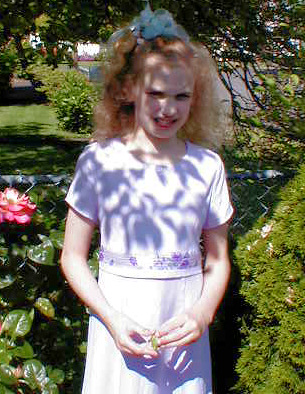
Rachel dressed for mass
Rachel all ready for mass

 The answer is a qualified yes.  From Guidelines for the Celebration of the Sacraments with Persons with Disabilities

Eucharist

19. The eucharist is the most august sacrament, in which Christ the Lord himself is contained, offered, and received, and by which the Church constantly lives and grows. It is the summit and the source of all Christian worship and life, signifying and effecting the unity of the people of God, providing spiritual nourishment for the recipient, and achieving the building up of the Body of Christ. The celebration of the eucharist is the center of the entire Christian life (Canon 897).

20. Parents, those who take the place of parents, and pastors are to see to it that children who have reached the use of reason are correctly prepared and are nourished by the eucharist as early as possible. Pastors are to be vigilant lest any children come to the Holy Banquet who have not reached the use of reason or whom they judge are not sufficiently disposed (Canon 914). It is important to note, however, that the criterion for reception of holy communion is the same for persons with developmental and mental disabilities as for all persons, namely, that the person be able to distinguish the Body of Christ from ordinary food, even if this recognition is evidenced through manner, gesture, or reverential silence rather than verbally. Pastors are encouraged to consult with parents, those who take the place of parents, diocesan personnel involved with disability issues, psychologists, religious educators, and other experts in making their judgment. If it is determined that a parishioner who is disabled is not ready to receive the sacrament, great care is to be taken in explaining the reasons for this decision. Cases of doubt should be resolved in favor of the right of the baptized person to receive the sacrament. The existence of a disability is not considered in and of itself as disqualifying a person from receiving the eucharist.

21. Eucharistic celebrations are often enhanced by the exercise of the diverse forms of ministry open to the laity. In choosing those who will be invited to use their gifts in service to the parish community, the parish pastoral staff should be mindful of extending Christ’s welcoming invitation to qualified parishioners with disabilities.

When we were looking into First Communion for Rachel we wanted two things.  We wanted to follow the teaching of the Church as hard as it can be sometimes when your child is disable there are things that won’t work for them, if it was determined that Rachel lacked sufficient understanding or was unable to receive reverently we would have accepted that and trusted that God would bless her life in other ways. But we wanted our child to be able to participate as fully as possible in the life of the Church. 

I was really sadded by the story of an eight-year-old girl who was intolerant of wheat and the way her mother decided to deal with the issue of her daughter receiving communion.  The only valid medium for the Eucharistic bread is wheat.  For those who can’t consume wheat they may receive the wine only and that is valid, every bit as much as the reception of bread alone.  What bothered me so much about the above news story was how the mother acknowledged that she knew that her daughter could receive the wine, but in her opinion an eight-year-old shouldn’t ingest any alcohol and so the entire Church would have to change the dogma of two-thousand years because she didn’t want her daughter to have a miniscule taste of wine.  “It’s not appropriate for children to drink alcohol,” she said. “Even a sip.”   The last thing I wanted to do when looking at this sacrament for my own child was to become so caught up in what I wanted that I missed what was resonable and right.  So the question of Rachel understanding that the host was not just a little snack weighed on me heavily.

There were some signs that Rachel did understand.  She had always been very caught up with food.  One cookie was never enough.  It was always surprising to me that she had never reached for or grabbed a host when I went to receive Communion.  But reason suggested that since she never had one she might not see them as food.  I was somewhat comforted by the idea that in “Cases of doubt should be resolved in favor of the right of the baptized person to receive the sacrament”.  I talked to my priest, to our Diocese director of the Office for People with Disabilities and to the Lord in prayer.  But in the end it was God, through Rachel, who let us know that she understood enough to receive.

 My small bits of advice gleaned from what I have read and my own experience:

  1. As your child approaches the age typical in your parish for First Communion speak with your priest and/or the person responsible for religious instruction in your parish.  Go in with an open mind and heart and explain your child’s situation as fully and objectively as you can.   Listen to what they say and consider it thoughtfully.The vast majority of priests want to serve their parishioner and they want to serve the Church and to do both faithfully. In my experience it has actually been the more liberal priests who are the ones most likely to say that your child shouldn’t participate in the Sacraments at all.  I have heard several mothers say that they went to Fr.             and he said their child didn’t need the Eucharist (or reconcilliation).  Sometimes going back with Guidelines for the Celebration of the Sacraments with Persons with Disabilities in hand is helpful.  Generally their reason for refusing is some idiotic banality about how “your child is so close to God already because their are disabled they don’t need to receive Communion.”   Don’t buy this, we all need grace.   It is one thing if your child really doesn’t understand that this is a special thing, a holy thing, and would not approach the sacrament with reverence, but not some fluffiness about not needing it.
  2. If you can not come to some agreement at the parish level don’t be afraid to go to the diocese.  I wouldn’t say just go straight to the Bishop, but if you need to you need to.
  3. When it is decided that your child is capable of receiving the Eucharist there are some wonderful resources for helping your child prepare. Meyer Johnson has communion symbols available for their products.  We used these to help create a social story for Rachel.  There are also some good books available for First Communion with colorful pictures and simple explanations.
  4. Test drive with an unconsecrated host if you think there is ANY chance that your child will spit it out or not eat it.  Reverence for the Body of Christ has to come above all else.  I know there are a few people who might think that sounds harsh, but if we don’t believe in the Eucharistic miracle what is the point?  I know personally the hurt that pulls at your heart when you realise that your child can do something because of their disability and how much worse it is with those lovely rites of passage like First Communion, but we are talking about the actual presence of Christ and the reverence that demands must trump parental sentiment.  When we were preparing Rachel for her first communion we brought home a half a dozen unconsecrated hosts and she was happy to eat it and seems to like the flat, tasteless breads.   I know that for some people with autism the texture is off-putting.  Be sure to let your priest know if a smaller bit is better.  For the rite to be valid only the smallest bit is needed so be sure to explore that option before the day if that seems appropriate. 
  5. You can also validly receive the wine alone.  The same caveat applies.  Be sure that your child won’t just spit it out, but if the bread is not working for you that could be an option to explore.  Your priest will most likely be happy to work with you on this.  Most parishes that I have been in have allowed the children to try a tiny sip of the unconsecrated wine before they experienced it in mass.  Some children really don’t like the taste and no priest wants to risk desecrating the host.
  6. If a packed First Communion mass would spell disaster for you First Communicant talk to your priest about about your child either receiving their First Communion as part of a regular mass or communion service.  Sometimes a small weekday mass works better.  Or see if your Diocese has masses for people with disabilities that might serve your families needs.


Finally, the Church wants to serve your family and your child, each individual member of the Body of Christ.  At the same time She is also trusted with safeguarding the sacraments and traditions of the Church.  Most priests, the US Bishops and Rome all echo that every being, no matter their state in life or their disability is of infinite worth, a full person of dignity and worthy of the utmost respect and they want each soul to participate in the sacramental life as much as they able to within the limits of their understanding and capabilities.


Catholic Homeschooling · My world · Uncategorized

So tell me about this homeschooling thing.

childrenathome.jpg

A good friend of mine wrote me last week to ask about “the homeschooling thing”.   Which delighted me to no end as I know their family would be fantastic homeschoolers.   I found in answering her questions that I have quite different answers to the questions “Why did you start homeschooling?” and “Why do you homeschool?” both of which I am frequently asked and then there is yet a different answer to the rarely asked question “Do you think homeschooling is better than school?” and  the more frequently asked “Are you nuts?”

Why we started homeschooling was pretty straight forward.  Our local public elementary school is struggling under the burden of several large and diverse immigrant populations, the omnipresent specter of standardised testing, and the typical ills of city schools.  Our parish school, in which our children were enrolled, went through a chaotic period, spiralling down into a toxic atmosphere and ending in a massive tuition hike before the school closed.  Homeschooling at that point was a minor desperate reaction to figuring out what to do, but one that we were hopeful would work well for us.

And it has.  Why we homeschool now really had nothing to do with why we started.  I enjoy homeschooling.  The kids enjoy it.  Take away the better curriculum, the more engaging material, the spiritually sound environment, the great support of our parish homeschool group, the childrens’ homeschool friends, the one on one attention, take all that away and I still would love homeschooling because I get such a kick out of watching the children learn new things.   Why we homeschool now is more a matter of lifestyle.  Once we broke out of the box we started learning new things about learning.  My husband and I are both self motivated learners.  We both read a great deal, try new things, like talking about ideas and concepts and pushing ourselves ever so slightly  each day to be more informed and engaged in life and learning.  Basically we are autodidacts.  So homeschooling fits us because our own experience has been that learning need not be confined to the classroom. 

So do I think homeschooling is better than school.  Well yes, for us.  I can certainly see how others might not have the same type of experience.   But good homeschooling would be very difficult for any school to match.  First because homeschooling is focused on educating a particular child (or relatively small set of children) to the best of that child’s abilities taking into account that child’s aptitudes and interests.  Secondly the nature of schools being political institutions creates a an atmosphere that is not educational in the classical sense.  Politically the goals of schools are quite different from the goals of a classical education; schools more train than educate.  Even where they educate the education is directed most commonly towards very utilitarian knowledge.   This isn’t necessarily a bad thing.  In fact as a citizen I certainly want the bulk of my community’s members to be trained in useful skills that create a good work force that provides me with the services I need.  But I want my own children to be educated in the sense that they become rational human beings with a deep understanding of their own faith, culture and the natural world.   As institutions schools will always be bogged down in administrative overhead that impacts classroom learning but doesn’t affect the family educating their own. 

So are we nuts?  (this is by far the most common question I am asked about homeschooling) ….  Probably.  But it is a happy nuts.