My friends, Jenifer and Jeff, had their sixth last night. I was very happy to have been there for the birth. Such an exciting time.
Author: darcee
Just one more Catholic wife and mother on the internet, blogging about homeschooling, living the faith and all that sort of thing.
Easter Week
Bloggin will probably be light this week as it is almost Easter, we have been sick for several weeks running and have fallen about 2 weeks behind for school, and, as always, there are about 15 million things for me to do.
More on Confession
There has been a lot in the news the past week and even more in blogs written about confession, both the Sacrament and the basic concept. In the news there have been two stories which have caught my eye. The first was that horrible misreporting of the Vatican announcing new, more culturally relevant sins and the second was a report on the trend to confess sins online. The Catholic Blog world has been much more rich with a variety of articles being written about Confession, first confession, the practice of the Sacrament, the renewed interest so many people are having with the act of just going in reciting sins and receiving absolution.
Now as most Catholics have picked up by now the main-stream news media is horribly out of touch when it comes to reporting on anything having to do with the Catholic Church. When it is the British Press just triple that. Amy Welbourn and Deacon Kandra had insightful things to say about this crossing of bad reporting and the secular media’s natural inclination to get fuzzy headed, silly, giddy any time they think they found something interesting to say about the Catholic faith. Dullards.
Almost as stupid is the CNN.com report on online “confession”. I wish I could say I was surprised that a national news source reported on the trend of “true confession” sites with such a religious sounding angle but at the same time showed little respect or understanding of the significance of confession in religion. It isn’t shocking simply because the press so often gets religion wrong. At least in this article they bother to actually talk to religious leaders about the sacrament vrs the online confession fad.
Around the blogs I read there has been a trend of some very fine writing about Confession in the Sacramental sense. Julie at Happy Catholic has a wonderful post and round-up of some of the best of these articles. I really encourage everyone to read them.
So tell me about this homeschooling thing.

A good friend of mine wrote me last week to ask about “the homeschooling thing”. Which delighted me to no end as I know their family would be fantastic homeschoolers. I found in answering her questions that I have quite different answers to the questions “Why did you start homeschooling?” and “Why do you homeschool?” both of which I am frequently asked and then there is yet a different answer to the rarely asked question “Do you think homeschooling is better than school?” and the more frequently asked “Are you nuts?”
Why we started homeschooling was pretty straight forward. Our local public elementary school is struggling under the burden of several large and diverse immigrant populations, the omnipresent specter of standardised testing, and the typical ills of city schools. Our parish school, in which our children were enrolled, went through a chaotic period, spiralling down into a toxic atmosphere and ending in a massive tuition hike before the school closed. Homeschooling at that point was a minor desperate reaction to figuring out what to do, but one that we were hopeful would work well for us.
And it has. Why we homeschool now really had nothing to do with why we started. I enjoy homeschooling. The kids enjoy it. Take away the better curriculum, the more engaging material, the spiritually sound environment, the great support of our parish homeschool group, the childrens’ homeschool friends, the one on one attention, take all that away and I still would love homeschooling because I get such a kick out of watching the children learn new things. Why we homeschool now is more a matter of lifestyle. Once we broke out of the box we started learning new things about learning. My husband and I are both self motivated learners. We both read a great deal, try new things, like talking about ideas and concepts and pushing ourselves ever so slightly each day to be more informed and engaged in life and learning. Basically we are autodidacts. So homeschooling fits us because our own experience has been that learning need not be confined to the classroom.
So do I think homeschooling is better than school. Well yes, for us. I can certainly see how others might not have the same type of experience. But good homeschooling would be very difficult for any school to match. First because homeschooling is focused on educating a particular child (or relatively small set of children) to the best of that child’s abilities taking into account that child’s aptitudes and interests. Secondly the nature of schools being political institutions creates a an atmosphere that is not educational in the classical sense. Politically the goals of schools are quite different from the goals of a classical education; schools more train than educate. Even where they educate the education is directed most commonly towards very utilitarian knowledge. This isn’t necessarily a bad thing. In fact as a citizen I certainly want the bulk of my community’s members to be trained in useful skills that create a good work force that provides me with the services I need. But I want my own children to be educated in the sense that they become rational human beings with a deep understanding of their own faith, culture and the natural world. As institutions schools will always be bogged down in administrative overhead that impacts classroom learning but doesn’t affect the family educating their own.
So are we nuts? (this is by far the most common question I am asked about homeschooling) …. Probably. But it is a happy nuts.
Illness
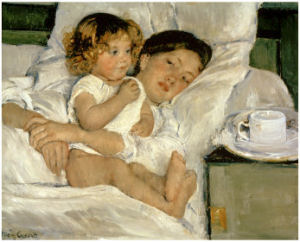
This weekend was a complete loss. I haven’t been so ill in years. I literally didn’t stir from my bed at all on Saturday and Sunday only managed to lay on the sofa in the living room and watch a couple Jane Austin movies while my family brought me tea and “Cream of Wheat” and generally did a very good job of taking care of me and leaving me mostly alone.
Today I am feeling better. Well enough to pull myself to the computer and do a small bit of work.
I have decided that the few days after I am feeling horrible are the worst. I can see what needs to be done but I really don’t have the energy to tackle anything. The house is in disarray, my sheets need changed and the bedding aired, the pantry is a bit picked over and I have no idea what Kyle has been feeding the children. All this I can deal with but at some point I need to brush my hair and wash it. I dread this. I have thick, coarse hair, with a good deal of curl that hangs to my mid back. Usually it is brushed and braided and in a neat little bun at the nap of my neck. Currently it is a sweaty, tangled mass, hanging awkwardly down my back and I am not quite up to the task of dealing with it yet.
Autism and Catholic Life
Being Catholic and the parent of an Autistic child has led to many questions that are unique to the parents of children with disabilities. “Should my child receive communion?”, “Does my child need Confession?”, “Is it a sin for us to miss Mass because of my child’s possible behavior?”, “Does the Church have any direction, programs, help for us?”. In order to help anyone out there also searching for answers I am sharing what we have learned over the years.
Going to Mass
It is not uncommon to hear: “I feel uncomfortable bringing my son to Mass. I know he is going to make sounds, he might get upset, it would be one thing if he was a baby, but at seven people stare. The stares are unbearable.” Parents all too often stop coming to Mass with their child with an emotional/behavioral disability out of concern that they will be disruptive. In some cases I think this can be warranted. But in general, most parishes will be very welcoming to a family if they know what is going on.
When we moved parishes after purchasing a new house we were very nervous about how Rachel would be perceived, what other people would think as she started hooting at the ceiling fan, what if she had one of her melt-downs? When we took our pew we were delighted to see another large family with a child who had those tell-tale signs. Instantly there was a bond, we became friends. The small parish was very open to its two little angles with the odd behavior quirks. The priest was accommodating and loving to the girls and we were relieved and happy to find an accepting place. You never know when you will be the family that gives hope of acceptance to someone else.
Don’t be afraid to call your local parish and schedule an appointment with the priest to talk about your disabled child. While there are always the few priests who give horrendous advice most priests are open and caring people who want the best for your child and your family. You may find there is one or another mass that is shorter, or the music more to your child’s liking, or even one where a family with a disabled child is already in attendance.
In some dioceses there are special programs for disabled people and their families. In Oregon there is The Office for People with Disabilities. They sponsor “adapted liturgy” which accommodates those who need something other than the usual mass. Pretty much anything is accepted there because everyone is in a similar situation.
If mass is simply too over-whelming for your disabled child you might have to miss mass. It is a valid exception to the weekly obligation to be caring for a child who can not attend mass. Most priests will be understanding of this, some will let you receive communion for the home-bound especially if you are a single parent. You also might get creative with your mass attendance: consider alternating parents staying home with one child while the other attends mass with the rest of the children, one parent attending a different mass, attending mass during the week while the disabled child is in school, or scheduling respite care so that the rest of the family can attend mass together.
The Sacraments
note: I am not a cannon lawyer, I am sharing what I have read and been told as a starting point. Please talk to your local priest and diocese about the exact procedures in your community. You also might read Welcome and Justice
for Persons with Disabilities from the USCCB and “Guidelines for the Celebration of the Sacraments with Persons with Disabilities“. I have pulled some quotes from “Guidelines” and added my comments below.
Baptism: Every child, no matter their disability is entitled to baptism.
Communion: This is the one that was very difficult for us. “It is important to note, however, that the criterion for reception of holy communion is the same for persons with developmental and mental disabilities as for all persons, namely, that the person be able to distinguish the Body of Christ from ordinary food, even if this recognition is evidenced through manner, gesture, or reverential silence rather than verbally.” For Rachel this was a hard thing to tell, she is almost non-verbal and finally it took a small miracle for us to see that she did have some understanding of the sacrament.
I have added two posts that more fully explain some of what we have done for First communion:
Can my autistic child receive communion
and
Confirmation: “To receive confirmation a Persons who because of developmental or mental disabilities may never attain the use of reason are to be encouraged either directly or, if necessary, through their parents or guardian, to receive the sacrament of confirmation at the appropriate time.”
Confession: “Only those who have the use of reason are capable of committing serious sin. Nevertheless, even young children and persons with mental disabilities often are conscious of committing acts that are sinful to some degree and may experience a sense of guilt and sorrow. As long as the individual is capable of having a sense of contrition for having committed sin, even if he or she cannot describe the sin precisely in words, the person may receive sacramental absolution. Those with profound mental disabilities, who cannot experience even minimal contrition, may be invited to participate in penitential services with the rest of the community to the extent of their ability.”
Anointing of the Sick: “Since disability does not necessarily indicate an illness, Catholics with disabilities should receive the sacrament of anointing on the same basis and under the same circumstances as any other member of the Christian faithful”
Community and Parish Resources: Don’t be afraid to ask. You might discover there are many resources in your community for your family. Even ask at your child’s school or pediatrician and don’t be afraid to share with them what you are doing for your child’s faith life. We found that our daughter’s teachers have often been very helpful in finding resources for helping Rachel in mass (social stories, board maker pictures, sharing what they know other families are doing).
Your Dioceses website should have links to any special ministries they offer, and as more families request these things more of them are developed. You may find your parish or a neighboring parish has a support group or would like to form one.
Last thoughts:Having a child with a disability can be a blessing and a cross. Keeping your own faith-life alive, finding time for prayer, time for mass, time for anything can be a struggle but the grace and peace of God can be that one thing that keeps you going. I hope that anyone who has read this will keep us in your prayers as I will prayer for those who read it.
Bless me Father….

As a convert to the Catholic faith I wasn’t raised with all the practices and habit of Catholic life. I didn’t grow up with table blessings and rosaries and mass every Sunday. In my RCIA we learned about many of these but there is a difference between the abstract knowledge of something and the actual doing it.
The one thing I have been struggling with the most is Confession. I could probably write a book about the “hows” and “whys” of Confession, in theory it is a wonderful, spiritual and useful practice. But in theory, oh my, how difficult it is to start. It took me eight years to start going to confession.
My priest is someone very easy for me to talk to. So we had a very good “pre-confession” meeting where I explained my situation. Going through RCIA I was preparing for Baptism so I didn’t have to “do” Confession as some of my classmates did. Those who were coming in for Confirmation met all together during Lent and made a confession. My sins, being washed away at Baptism, didn’t ‘count’. I suppose I could have gone to Confession at that point, but it wasn’t required so I didn’t. After our Baptism we were left to our own path. Mine avoided the confessional all together. And it has eaten at me all this time.
I longed for Confession; I needed it. I could feel the block working against me and keeping me from progressing in my walk with Christ as completely as I should be. So finally I screwed up my courage and took the plunge and met with my priest and just did it. Yeah me.
The part I found the worst and best was the examination of conscience. This is by far the most difficult thing to do. I found it helpful to have the printed “help” so I could look at it, think about it. Sin isn’t about feeling guilty. It is perfectly possible to sin and feel no guilt at all. Feelings are not a good indicator of guilt. The human conscience is a malleable thing and I know that if I allow myself to do certain things or think certain ways those things begin to seem justified and eventually right no matter how objectively wrong they are. I need to compare my actions not against what I feel to be correct but to what is objectively right.
One of the saddest losses in the Post Vat II era has been Confession. My priest expressed it very aptly when he said that the “face to face” confession has been disastrous experiment. The confession is not supposed to be a heartfelt talk with a friend nor is it a counselling sessions, though I suppose it can have aspects of both. The confession should be the opportunity to reconcile oneself with God and with your own soul, your own better self.
In retrospect I really wish that my RCIA program had met longer after we were Baptised. I think I would have been helpful to have had a “First Confession” meeting about a month later. This would seem to me to be helpful for the newly Baptised Catholic. But I suppose that Reconciliation is one of those things that really isn’t in favor in the American Catholic Church. I have read several articles this year about how Confession is coming back into “fashion”. Some Dioceses are encouraging the laity to come back to the confessional with formal programs such as The Archdiocese of Washington’s program “The Light is on for You“.
Waiting for Rain
Over at Simple Gifts I found the above video.
I suppose it is the greatest of Christian challenges to just live for God. I know a great deal was made of Mother Teresa’s journals when they were release about ” The dark night of the soul” that long period of spiritual dryness that she, and so many great souls, faced. To me it was a blessing to know how she felt. Our world is a place where there are many dark Corners, where the light is sometimes difficult to see, or worse burning so pure and complete as to make us feel not just naked but transparent.
We are halfway through Lent and Easter is edging closer everyday. In ways this has been a very good Lent for me, in others it has felt somewhat disconnected, I guess would be the right word. I am looking forward to Easter. I can feel the journey through Lent building. When I was a child living in Eastern Oregon storms never felt sudden. You would see clouds gathering in the distance, the wind would begin to pick-up then the smell of the rain in the distance. Easter is like that for me this year a distant storm that grows and travels, I can feel it and hear it and smell it coming. I am waiting in anticipation, but I am not sure exactly what will be.
Moments of pure gold.
This weekend I found the video that I had originally wanted to put with this post so I am bumping it. I hope no one minds. Thanks to the Anchoress.
A couple weeks ago the Anchoress took a little break from blogging and on the way out left us with a link to an essay about Johnny Cash which can be found here. I read the essay really hopeful, ended up somewhat disappointed, but came away with a few useful thoughts. Key among these thought was this: God can bring the worst of us to moments of pure gold for His glory and for our good.
I will try to help you understand what I mean by that. One of the first few comments following the article was this, ” A rather shallow article about an unrepetant[sic] sinner. Can’t Catholic writers do better than this?” I have seen this attitude from my fellow Catholics far too often and Christians in general more times than I could remember. A slightly “holier than thou” attitude, pleading to the good that is really nothing more than thinly veiled self righteousness that smacks of deep-grained ugliness. This is not the light and saving love of Christ, liquid and vibrant, blood and flesh, fertile and open. It is a brittle, dried up attitude that claims itself superior while becoming more and more detached from the obligations of need and weakness on the human heart. It is the Pharisee and the Priest crossing to the other side of the road — tisking at the sinner, crime and the state of world while offering no balm to sooth it. And the greatest irony is the sinner they are tisking in the above comment was the one offering the balm to so many.
McMullen spends a good deal of time quoting Cash’s lyrics and relating them to his feelings as a Catholic. It is all in all an enjoyable read. But I feel it really didn’t go deep enough. There are two thoughts I feel are important.
First Cash is a man of his time. His voice spoke to men, hard working country men, men struggling with modern life and men for whom the Church had taken a feminizing turn that really turned them off. His songs struggle with faith as I am sure the man did, as many men of his generation did and many still do.
Second that Cash’s personal character and the state of his soul had very little to do with ability to serve as a tool in God’s hands. This is a thing that slips the minds of many Christians I fear. God doesn’t need us to be perfect, good, or even trying. God doesn’t need us to be in a state of grace, saved, believing or even wanting Him. He can take us while we are running at a break neck speed straight to the gates of hell and wring out of us something good. Sometimes for our souls and sometimes to save someone else.
If you want to save the earth…
Every once in awhile I read something that makes me outright chuckle. Last night I was sort of surfing around and I found a little gem. “You want to save the earth? Here’s a little hint. Don’t. Buy. Shit.” It was tucked away in an article over at Pajamas Media; Desperate (Green) Housewives. The article is a response to another at the New York Times which more or less takes a sarcastic look at the antics of suburban mothers consumed with “ecoanxiety” who are doing little things and spending lots of money to make the bad feelings go away. Laura McKenna takes the game a little further and points out the erratic hypocrisy of that particular style of “hip” green living in general.
I really had to laugh at the whole thing. What are those bad feelings called? You know the ones you get when you realise that your 4000 square foot house that is home to four people creates a huge tax on resources, not to mention all the stuff that it is filled with? The favored phrase is “ecoanxiety”, of course, anxiety is something that sounds treatable, pop a pill and relieve your anxiety, treat that symptom, get over it. It is a term coined to express an interior reality, a trick of the mind, a feeling that is rooted in mindset, something you should be able to just get over. If you call it what it really is, if you dare speak the word “guilt” then you create an external reality. With guilt there is something real wrong, something you must correct. There is no quick pill to take, you must repent to fix what you are doing. Guilt supposes a moral judgement.
If you feel guilty because your lifestyle is consuming more resources than is equitable than that is where you should start, your lifestyle. All those little pacifying “baby steps” might be better than nothing and they might make the “Green Moms” feel better, but the root problem, the core issue is left untouched.
 Simply Catholic