Catholic Homeschooling · Mary Mary and Martha · My world

Washing

When you have a large family laundry becomes a project.  It is not a matter of tossing half the clothing you own in the washer and then taking off for the day.  When you have a large family the laundry must flow.  Or you face the horde looking at you half dressed wondering where their socks and pants are while you are frantically trying to find one clean shirt while trying to get out the door for an appointment. I have already written about our laundry containment system of multiple hampers.   Now, I will get down to the nitty-gritty of washing. 


In our laundry system the clothing is already sorted into five main groups: darks, lights, whites, bath towels and kitchen towels (which include aprons, oven-mits, napkins, and shopping bags).  Hand washables, delicates and dry-cleaning items are also sorted out.   We have enough clothing that there is still some sorting that ideally will take place at this point.  Heavy dark clothing is separated from light-weights darks and lint givers from lint collectors go in separate loads.


As the laundry is separated I check for stains again and check pockets and zippers closers.  If zippers are closed during the wash they won’t snag other clothing which can damage the zipper or the other item.  This also applies to buttons and snaps but is more important with zippers.  I remember having a conversation with someone years ago about having to check the pockets before sending things through the wash. Her take was that everyone should take things out of their own pockets (especially husbands), and of course she is correct, but considering we are living in the real world where people forget things like that I check them.  I think it is one of those cases where you can be right all you want but reality isn’t going to comply with you just because you are.  Sort of like crossing a street at the cross walk, sure the pedestrian has the right of way… but the car is going to hit you pretty hard if you don’t pay attention to it.


A bit on stains:


There are many wonderful stain removal products on the market and some good homemade alternatives.  Ohio State University has a wonderful article about laundry, including does and don’t for stain removal. 


The most important things to remember when trying to get out stains are:

  1. Timeliness – Almost all stains respond better to quick treatment and may even become impossible to get out if allowed to set
  2. Don’t get creative – most stains have well known removal techniques.
  3. Follow the directions – Both the washing directions on the garment and the product.  This includes spot testing, soaking time, water temperature, et al.
  4. Start with the least extreme option and go from there.


Before tossing something in the machine I also check to see if there is any quick mending that needs done.  Some things will get worse in the wash, loose buttons, fraying rips and will probably need mending before they are washed.  Something like a falling hem is more a judgment call they might be worse or not.


Washing:

As I have mentioned we have an energy efficient large capacity front loader.   Any large family will do itself a huge service by using the most energy/water efficient machine they can afford.  When you are washing three loads a day the cost of electricity and water add up fast. 


I am really hooked on my front loader.  The clothing seems to come out cleaner, it runs faster and it is gentler than my old top-loader with agitator.  The delicate option is actually delicate enough to wash many of my hand wash items.  I haven’t been brave enough to trust my underwires to it.   A lingerie bag is nice to use in the wash and I have read about special cage like things called “bra balls” that can be used in machine washing your bras, but I haven’t tried one myself.  I actually don’t mind handwashing delicate fabrics.  Especially when I can use a nice smelling detergent, warm water and let them dry hanging in the bathroom. 


If you have never tried it you might want to look into blueing.  It really puts the sparkle back into white clothes. 


Drying: 

Line drying vrs the dryer.  Well, hands down line drying wins in theory.  It is energy efficient, better for your clothing, and all that is good and right.  But drying outside here in Western Oregon is problematic… considering anything hung outside after mid November is likely to be just as wet in mid March.    I have limited space indoors to dry, so it is the dryer to the rescue for the winter months.  During the summer I have gone through outdoor drying spells, but I need a better line system to make it really work.  I am researching the options and will try to get back with something sensible when I nail down the details.


For sweaters and other items that are flat dry I have a drying rack.  Actually my drying rack is broken and I am afraid I need to invest in another one.   But a folding one that comes out to do its work and then hides neatly away is perfect for our household.


Once clothing is dried I try to make sure it is folded and put away as soon possible.  I hate baskets of unfolded clothing getting all wrinkled and making it difficult for me to find the things I need.


I have for a while been considering ironing before things are put away, but have never made the switch.  We generally avoid things that need ironed.  I am awful at ironing.  For some reason I end up ironing more wrinkles in than I get out.  I use a spray starch on occasion and love the results.



Catholic Homeschooling · Mary Mary and Martha · My world

Saving money on food: the super basics

As you probably know the price of food has been on the rise.   The USDA is projecting a 5% possible rise in at home food costs.  This is of course hitting at a time where many families are already stretched as far as they can go.   So, how do you save money on food.

First off quit eating out.  Basic, simple, good for your bottom line and your waistline.  Eating out, especially eating fast food, is horrible for your family’s health.  Eating out is terrible for you and worse for your children.  High in fat, high in sugar, large portions and low nutritional value is the norm in fast food and most restaurant food.  All that together means that stopping through the drive-through or calling for pizza should be a rare treat.

Reduce the amount of prepared foodyou purchase.  Convenience foods are convenient, but they cost much more per serving and are lower in nutrition than the home-made counterpart.  With the possible exceptions of ramon noodles and cheep boxed mac-n-cheese they cost more.  But when you start looking at nutritional value added in then the cost is not offset.  Things like cookies, crackers, chips, boxed meals, TV dinners, cake mixes are more costly than the made-from scratch versions and are higher in fat, sugar and preservatives.

Control your shopping.  Use a list and shop less.  If you create a menu and a shopping list you can help avoid “quick” trips to the super markets to pick up “one or two things” that cost your family a bundle in time, gas, and those little impluse purchases that sneak into the cart.

Menu planning  is perhapes the single most cost effective measure you can impliment.  First it allows you to follow the first four points more easily and second it helps you stay within your budget while you shop.  If you know what is on the menu for the rest of the week, have the needed items purchased and in your fridge and pantry, stopping by the local fast food joint is much less of a temptation.  Menu planning also allows you to make the most of super market circular sales and coupons.  It also allows you to avoid waste.  I can’t tell you how often food has gone bad before we ate it.  With a menu plan the letuce and peppers in the bottom of the fridge will not be going bad nearly as ofter.  Left over nights can be scheduled in and they can be eaten before the left-overs become a bio hazzard.

Mary Mary and Martha · My world · Simplicity

Laundry – the system

I mentioned in my first article, briefly, about laundry systems.  Today I plan to expand on that a bit more.    The USDA survey on the cost of raising a child estimated that parents spend roughly $575 per child per year on clothing.  As with most things of this nature I look at that number and think, “Wow, that seems a bit high.”  But if I was buying everything for the children new, and including foot wear that seems a possible number.   No matter how you look at it clothing is an expense.  Caring for you clothing to keep it looking nicer longer makes sense on every level.   When you have a large family having a system is imperative.  I can think of nothing more frustrating that trying to get three, four or five children out the door while looking of missing socks, the favorite sweater, or the ballet tights that are hiding somewhere in the house only to be discovered under the bed and very dirty.

A long time ago I read about space planning and functionality.    It might even have been in college, but be that as it may, a large family either plans its space for functionality, luck out and creates systems naturally or it fights the chaos that lack of planning creates.  Laundry is no exception.

I view the laundry process as starting when the clothing is taken off.    Clothing coming off a person falls into about 5 categories: it is going to be worn again before it is laundered, it is going into the regular wash, it needs to be hand wash or dry cleaned, it is stained and needs treated, it is exceptionally dirty.  This is the break down of the decision point of the laundry system:

It is going to be worn again: Jackets, coats, “church clothes”, basically anything lightly worn that doesn’t need laundered gets a quick look over for any missed spots and then gets hung up and put away.

It is going into the regular wash: This is the bulk of our clothing.  These cloths go into the hamper in the room they are taken off in.  When I have fewer children (my mom’s system) the laundry was take to a central  hamper in the laundry room.  Or it got left on the floor of the bedroom or bathroom.  This can work for bigger families, but I have found it easier to have hampers in dressing areas so that young children can drop their laundry into it themselves without having to leave the room.

It needs to be hand wash or dry cleaned: These items are mostly mine to start with, they have their own small hamper in the closet in my room.  When the children are wearing something special that needs hand washed or dry cleaned I will make sure that it gets separated.

It is stained and needs treated:  The best time to catch a stain is when it happens, the next best is when it is taken off.  If something has a stain my goal is to nab it right after it is taken off, take it to the laundry room, treat it with the appropriate stain remover and sort it for washing.  Sometimes I miss this and don’t catch it until it is gone into the wash.

It is exceptionally dirty: Every mother is experienced with this one.  I cringe to remember nights where one or more child was ill and vomit covered laundry dominated my life for the day, toilet training accidents,  “Mommy we were playing farm and I got to be the PIG!” – mud covered things can not go into the wash right off.  These items don’t even get sorted.  They just get dealt with.  Sometimes a bucket soak or sink rinse is called for, other times the soak cycle on the washer is needed.  On rare occasions I have looked at something and said, “this is not worth it, I would pay the cost to replace this item rather than wash it”, and out it goes.

Step Two:

Once items make it to the laundry room they are sorted into five baskets.  There is a small basket of kitchen laundry,  the laundry room is right next to the kitchen and I dislike having the dish clothes and such in with the other laundry.  There are also four tall hamper baskets that clothing is sorted into as it comes into the laundry room.  Darks, bath towels, lights and whites (bleach-able) clothing each have their own basket.  Things that need to go through the delicate cycle go into a small basket on the top of the dryer.  In part this system developed because no one hamper was quite big enough for the job and in part because of the system I used while living in an apartment building.  Presorting the laundry makes life that much easier for me.  

While the laundry is being sorted it is given a quick check to make sure there are no missed stains, rips that would be made worse in the wash.  Pockets are checked, zippers zipped, everything is turned right side out or inside out depending on the washing instructions.   One of the nice side effects to the multi-basket system is that it is very easy to see when we are falling behind on the laundry or on a certain aspect (bath towels is the winner here).  It is also a good reality check for the clothing glut issue.  If I can’t sort all the clothing into these baskets then we have accumulated too much.

When a load is ready to be started we pull it out from the hampers.  I try to check again for stains, open closures, turned pant legs, folded socks and the like.  You might have noticed that I have a lot of redundant checking in the system.  This is an example of “the plan” vrs. “the reality”.  In the plan everyone cleans out their pockets, turns out their clothing and let’s me know if there is a stain.  In reality, pens are stuck in pockets of jeans with underwear and socks tangled in the inside out pant legs and since I may not be the one checking for these things in one particular step it make sense for me to check on all the steps rather than deal with the mess afterwards.

 coming soon… Washing, drying, ironing and all that sort of thing

Blogs I Know · Mary Mary and Martha · Simplicity

Simply Lovely Laundry

Six children and two adults make for a bit of laundry each week.  Large family logistics seems to be a topic of interest to the general population.  “How do you do it?”, is one of those very frequently asked questions.  For the most part running a family of eight isn’t that much different than running the more common four person household — the scale isn’t so different as to make that much difference.  But in laundry you can feel the difference.

For many years I have really compounded my laundry problems by simply having too many clothes.  My mother-in-law made the observation when she was watching the children while I was having Josh and I actually did take the advice to heart.  We just have too much in the way of clothing and linens.  At some point after my mother-in-law made her pointed and on point observation I started seriously trying to assess the laundry problem.   The basic situation is frustrating, broken and ridiculously time consuming.  Too many clothes means more time collecting, sorting, washing, drying, ironing (or not), folding, storing  and trying to find the one thing you need when you need it.   It also means the laundry system is more prone catastrophic failure due to the slightest disruption.  One damp washcloth in the wrong basket can lead to a not so nice discovery three days later in the middle of the summer.  So something seriously has to be done.

Pegging the Problem 

I realised that while I was growing up my mother had a system for doing the laundry that I had more or less followed and the problem wasn’t really the washing as much as the management.   She was washing for four people and I am washing for seven usually and that breaks her system.   My bottle neck is one of volume.   Basically for our family laundry problem beings in the closet and dresser, maybe even the store and certainly in those very kindly and very appreciated boxes and bags of donated clothing from friends and family.

The reality is that I have a problem with my laundry and then I also have a problem with the children’s laundry and they aren’t exactly the same problem.

Once upon a time I was a clothes horse.  I love buying clothing, sewing clothing, wearing clothing and I could always find an excuse to spend a little extra on good construction and fine fabrics.  In fact some of my clothing from 10 years before would  still in good shape.  Not because it has been in storage, but because it was quality to start with.   I would meticulously care for my nicer things, my silky under things were always hand washed, the dry cleaner was on a first name basis with my skirts if not myself and (despite being a natural slob) I took care of those items because I valued them.

Somewhere between having children and staying home that stopped.  I am not completely sure why, but I haven’t really thought about it before today and it makes me sort of sad in a way.  It feels sort of like I have given up on that part of myself and I am somehow discomforted by that realisation.

One of the first things I realised that my “fussy” stuff never got washed once I had child number four.   When I was working fussy stuff got dropped off at the dry cleaner, but after a bit of time home I realised that my “dry-clean only” bag was actually a dry-cleaned-never bag and out it went.  But then the few hand washed things started getting washed less and less too.  They just hung around not getting washed.  Little stockings and delicate slips sat accusingly silent on the dryer each time I walked into the laundry room wondering why I had given up on them.  Oh, I had my reasons, I was too tired, too out of shape, pregnant, nursing, taking care of a small baby who would likely puke on me approximately 54 seconds after I put on something special… so why bother?  Socks became a much higher priority.

Maybe since my youngest is two I am starting to think it would be pleasant to wear something other than t-shirts and whatever pants fit this week, or over sized sundresses that hung off my shoulders somewhat resembling a tent.  I don’t know but this is an idea I will have to play around with a bit more.  It is sufficient to say that, for the moment, my clothing needs some serious rethinking but this evening won’t be the time to do it.  It would be nice to be at the point where my clothing is practical for my situation and station in life, but still pleasant and beautiful.  I know how to work this problem, this I can tackle, but it will require some inventorying and planning.

Which is basically how I started working on the far larger problem of the children’s clothing.  Once I realised that the volume of clothing we own surpasses what we need or can even deal with I had to find a way to cut down.  So, being the geek I am, I started researching wardrobe planning for children on the internet.   I found some good basic information on wardrobe planning, it reminded me and reinforced what I had learned in my clothing design coarse in highschool, but these weren’t what I really needed.  I stumbled on a document that was a clothing list for children of various ages in foster care and then that got me thinking and I spent a little time researching the recommended clothing lists for a few boarding schools.  This was mostly to give me an idea of what was sensible for a child to own.  Not that I couldn’t come up with it on my own, but looking at what these various institutions recommended gave me a better and more realistic starting point for my own children’s clothing lists which I eventually made out, put into a neat little spread sheet and then went to work de-cluttering the children’s clothing. 

The List

What does the typical child really need in the way of clothing?  I must admit I really liked the basic, straightforward, practical and simple list of the boarding schools.  They acknowledged, some through centuries of use, that children have lives that require a variety of clothing.  Church and parties, shopping and museum trips, athletics, art, nature hikes and just lounging around.  But they also are places where space for storage is either at a premium or essentially non existent so having too much stuff isn’t an option for anyone.   So the list of what is allowed is basically limited to what is actually needed.  A few were even specific enough to say that extra clothing would be sent home… they mean business apparently, but I doubt any of their charges didn’t have appropriate clothing for everyday and every activity. 

So taking these lists I sat down in front of my spread sheet and thought about what my children do and what they need.  We don’t have a uniform per say,  but it wouldn’t be hard to say that one shirt = one uniform shirt and a study pair of jeans or slacks serves for uniform slacks.  Jumpers and turtle neck sweaters take the place of uniform jumpers and uniform turtle necks and a homey sweater serves for a school uniform sweater quite nicely.  Add in ballet leotards,  swim suits, and dump the school blazer off the list and before long I was looking at something manageable.  For the babies and toddlers I planed on five days of normal wear, a couple extra pair of sleep wear and pretty much followed the same plan.

I got to the end of this, looked at the list a felt a wee bit overwhelmed.   It seemed like a lot of stuff.  Ten ones-ies for a baby, four short sleeve shirts, 4 long sleeve shirts and so forth.  But when I got down the the actual going through the clothing I was shocked.  Even being generous and letting an extra t-shirt or two in I was basically halving the clothing the children owned for most things and in some cases I was getting rid of a lot more.   Then there were a few things that we didn’t have.  Christopher had way too many socks, Josh not enough, this was something I knew but hadn’t taken the time to really sort out because I was too busy digging through a ton of unmatched socks trying to find something close to what I needed.  

But dumping so much of the extra made it possible not to just fit everything in the drawers, but to also store the off season things sensibly.  When I got one of those sweet people in my life handing down clothing I made myself get rid of something old… and this lasted for a long while then I ended up getting about eight bags and boxes of things within about a month.  The structure couldn’t hold up so now I am going through things again and getting us down to the essentials.

On to the laundry room

The system I use for the actual laundry is wonderful for us.  It works, it’s simple, it makes sense.  First off we invested in the most energy efficient and high capacity washer and dryer we could afford.  Not a matching set,  because we found that often one item of a set was rated far higher than they other, so they don’t match but after doing the research on the models available to us and within our budget we ended up with what we have.  When we bought our first energy efficient washer I noticed a real drop in our electric bill.  I think it paid for itself in less than two years. 

We have five baskets.  Four tall ones and one small one.  The tall baskets sort the laundry into whites, light colors, heavy/dark colors and towels.  The small basket holds the kitchen towels.  This makes it easy to keep the loads sorted and to see what needs washed “right now”.   Even the little kids can handle this sort of sorting system.

 More on my laundry system


Mary Mary and Martha · My world

A Good Wife


Every once in a while I do  google search for “Good Wife”.  I really enjoy just reading what people think being a good wife entails and how that works itself out in the real world of day to day marriages.  It is also funny to stumble on the different humorous takes on the very idea of being a good wife.  In some circles it seems that even asking the question,  “what should I do to be a good wife?”, is going to make the fur fly.  Take Minette Marrin “the Good Wife is an Old Fashioned Realist“,  the article is interesting, the comments are at times painful.  They make me question the reading comprehension skills of a good number of the commenters.

Marrin lays out a very straightforward and pretty solid point:  “One hard fact a would-be wife has to face � and I was absolutely horrified to realise this myself � is that it�s not possible for a married couple to have two demanding jobs and children and a good relationship. Something has to give. ”   This is a point that seems lost on the detractors in the comments as they are too busy having conniption fits over the idea that a woman is advising other women to step away from the work-force and concentrate on their marriages and childrearing  while they have young children.  Or at least to think about it.  One would suppose that in a world where divorce teeters at near 50% and adultery is more and more common that it would be pretty obvious that marriage, for many people, is failing.   There are many complex societal reasons behind this but the stress of two career parenting is certainly one of them.

If the couple decides that one of them staying home (and yes, dear sisters, usually that means the mom) to raise the children and keep the home is what they are going to do to help reduce that stress then how that plays out is important.  We have done it both ways.  Both Kyle and I have taken a turn at the stay at home parent thing while the other worked.  The fact that he did it for a year and a half and I have done it for seven speaks volumes.  It wasn’t just that he felt very boxed in at home, but I felt wretched working while my little ones were home with dad.  So I stay home, he works.  Other couples might find other arrangements suit them better.  This works for us.  As long as I am going to be home I want to be good at it.

It is kind of sad to me how often the question, “How do I be a good wife?”,  is all but scoffed at.  Several years ago I was a member of a homemaking board where I was pretty active on the “messy” forum.  (I will admit to being a complete failure at housekeeping.)  At one point the conversation turned to the question of what husbands do around the house.  Many of the members felt that it was unfair that their husbands came home from work and then didn’t do so very much to help out.   I made the mistake of commenting that, since my husband put in a full eight hours of work (usually more) at the office plus the commute, I didn’t really feel right asking him to do any housework unless I had put in that much time at home during the day.  I think how I actually put it was “When I put in eight hours of solid housework here per day then I will think of asking him to do more.”  You would have thought that I was advocating that women great their men at the door in lace teddies and high-heels, martinis in hand, purring like a kitten, with a five course meal waiting on the table and only saying, “yes dear”, the rest of the evening.   Were the other women on the board upset because of how many hours they put in compared to their husbands?  No, they had all admitted to being rather slack while at home, daytime TV was a favorite topic of conversation, as well as the obvious time some of them spent online.  They were offended at the very idea of putting their husbands wants and pleasure as a priority… or even just cutting a tried guy some slack at the end of the day.   Needless to say that sort of soured me on that particular board.

The instant “what the husband wants” is put forward as a topic some women will rabidly grab that and start getting worked up about “Who is concerned about what I want?”  Any relationship where two people are worried more about what they are getting out of the relationship then what they are putting in is doomed.  But all it takes when there are two decent people and a modicum of affection is for one person to start saying, “What can I do to make you happy?” and that can change everything.   But that isn’t a popular sentiment and certainly not one you read in the Times very often.  So I was delighted to see Minette Marrin give voice to the question.  One of my favorite quotes from her article is:

“When you want to please your child, or your lover, you think hard about what might make them happy and then do it. It�s not a chore, or even if it is that hardly matters; it�s an act of love or of loyalty. Yet strangely, in marriage this obvious motivational technique seems to wither away with the wedding flowers. Women are convinced it is their right not to have sex when they don�t feel like it, and it is a man�s duty to wash up, though he hates it � and so it is, of course. But that�s not the point. Granny was right; never say no, and never nag. “

Anyone can clean a house, cook a meal or change a baby.  But it is love that makes it homemaking.  While “putting out”, cleaning-up and cooking are the most oft listed items on the list of a “Good Wife’s Duties” the real gem is love and service.  When we serve those we love the service is light, easy and a pleasure.  I hate cleaning up, but if I am cleaning up because I know it will delight my husband when he gets home and I love him then it become a weird pleasure. It is all in the motivation.

Yes, I probably did my career irrevocable harm by staying home to take care of the kiddos.  And yes there are times when I am here pulling my hair out wondering what the heck I was thinking when I signed up for this.  But I also wouldn’t change it.  I have a great deal of liberty to order my life in a way that suits me.  I very much enjoy being here with my children and watching them grow and guiding their learning and it is my husband who makes that possible by going out and working.  We have chosen the traditional arrangement and it works for us.   If I was focusing just what worked for me, what brought me personally the most satisfaction, I might have chosen differently at first.  Because I liked working.  I like the praise and the pay and those tangible rewards.  But there is more to “us” than “me” and probably the most short sighted thing I could have done would have been to make “me” a higher priority than “us”.   Because, while I enjoyed working, I enjoy this life so very much more.

40 bags of stuff. · Mary Mary and Martha · My world · Simplicity

40 Trash Bag Challenge: week one

This is week one, day one, of my 40 trash bag challenge.  If you remember the goal is to get rid of 40 bags of stuff from my home in eight weeks.  A somewhat daunting task if I think about it, but no where near as daunting as the fact that I know that it can be done…. that there is that much “stuff” poked into corners, shoved into bins, stuffed into closets, draws and Lord know where in my house making my life more complicated every day. 

Mary Mary and Martha · My world · Simplicity

Frugal in the News

Being a frugal homemaker is news worthy.

 If you are anything like me the article isn’t ground breaking and is hardly even news.  Though it is kind of neat to see something positive about not spending money in the news.  One quote from the article “It really doesn’t matter what you make. It matters what you spend.”  So very true.  The illustrations of the family spending less than half the average American family on groceries and cruising yard sales for toys is fun, typical among my friends, but fun to read.

It brings to mind an article I read a while back about “green-moms” and how mind-boggling they make the old adage “use it up, wear it out, make it do or do without”.  Thrifty living is essentially very “green” because it is based on the idea that less is more.    Or as I quoted in the above article, “You want to save the earth? Here’s a little hint. Don’t. Buy. Shit.”

I will make a little online confession here.  I love money.  I love to play with it, make budgets, see how far I can stretch some amount.  I really do enjoy money management and budgeting.  Yes, I know that makes me a part of a tiny minority, but I it isn’t something I apologize for because it serves my family so well.   I haven’t always been this way.  When I was younger I couldn’t spend my money fast enough.  But I have learned a lot since then and the skills I learned I am trying to pass on to my children.

40 bags of stuff. · Blogs I Know

40 bags of stuff

40trashbags.jpg 

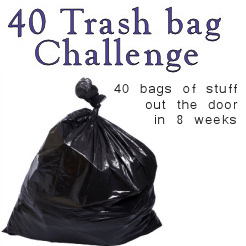
I was hit by a bit of inspiration last week over at  “In the Heart of My Home“.    That empty box says so much: Elizabeth has been busy getting rid of stuff.  I can’t help but want to follow her lead being that I am overwhelmed with stuff.  So I am issuing a challenge to myself (and anyone else who might care to join in) 40 bags of stuff out the door in 8 weeks.  It can be donated, tossed, handed down, recycled or otherwise disposed of, but it can’t stay here.  It can be clothing, papers, toys, things of any sort, but not the usual trash.

While I was thinking on this I figured that the size of the bag is up to you (I will be using the big kitchen size).  Some people have less stuff to de-junk and others have more so if you want to play along you might opt for a different size trash bag.   That sounds perfectly reasonable. 

I hope you join me and have fun.  As often as I can I will be posting updates here on my progress.