Why am I Catholic? Because:
Author: darcee
Just one more Catholic wife and mother on the internet, blogging about homeschooling, living the faith and all that sort of thing.
The Simple Woman’s Daybook – June 15, 2009
The Simple Woman’s Daybook
is hosted by Peggy at The Simple Woman’s Daybook
Thank you Peggy.
FOR TODAY : June 15, 2009
I am so sore today from yesterday’s hike up Multnomah Falls. But I survived it.
Outside my Window – I can see the first little cherries turning red. This is very exciting. This week we plan on going strawberry picking so we can put up strawberries for the year. My flowers need watered, my gardens need weeded and the lawn needs mowed again.
I am thinking – About next years plans. I have a good start on the planning, but there is still a lot to do. I would like to have it all done by the end of the month so it is ready to go when we get back from our travels later in July and August.
From the learning rooms – Next years plans have taken over. We still have some work to do this summer. We are going to be doing some fun activities and projects. Ashley is out of school for summer. She has her summer reading list and art portfolio to work on.
I am thankful for- Very patient people hiking with us yesterday. I didn’t realize just how horribly out of shape I am. Now I do. Need to work on that.
From the kitchen – Nothing much today. Ashley made cookies yesterday. Tomorrow I plan on doing some sourdough.
I am reading – Home Comforts. I am loving this book right now.
I am hoping – That my legs stop hurting sometime today. That the sky clears up. I think today is going to end up busy.
I am creating – A new dress for me.
I am hearing – Hannah keeps telling Josh “stop that”. Poor Josh is getting himself in trouble, mostly because Christopher isn’t here to occupy him. Christopher is off having fun with my parents on his “big trip” to California.
Around the house – We have an extra dog. My parents yellow lab is hanging out here with us.
One of my favorite things – Ibuprofen.
A Few Plans For The Rest Of The Week – More lesson planning. A little baking, a little sewing and some fun with friends. Nothing too exciting.
A picture I am sharing:

So, about that dress
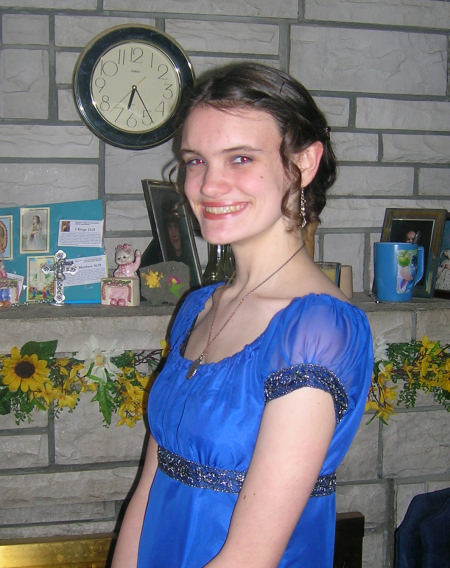
Here is a couple pictures of Ashley in the dress I made her.
and
Homeschool – Planning for Next Year – Lesson Plans
At this point I have the subjects and the books selected from the children for next year. Now I turn my efforts to getting it all organized. I won’t pretend that my way is the only way, or even the best way, it is just the way that works for me so far. And that could change. Many of the ideas I use I have drawn from other people, websites, books, and observation – none of it is really rocket science either.

I admit I have a “thing” for binders. So I set up a “Lesson Plan” binder that contains the lesson plans for each child, the weekly plan calendar which lays out the plan for our family learning each week, the children’s weekly folders where I put the children’s daily checklists and any worksheets that are needed for the week. This might sound like things are getting repeated all over the place, but there is a certain practicality about it – at least to me.
The Lesson Plan Binder:
I have a durable binder one inch binder that I use. It is divided into four sections, one for each child. Each section contains a copy of the subject list with texts, each subject laid out on a planner page and the book list for each child.
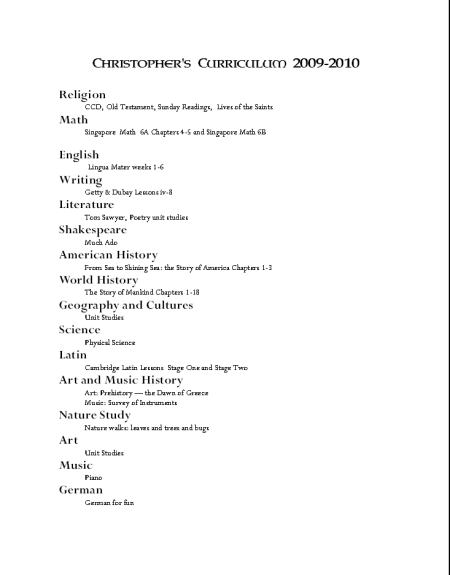
Then each subject is laid out for the 12 weeks on planning pages. I have five columns for days of the week and one column for notes, the 6 weeks per page so each subject is a 4 page spread. This allows me enough space for writing. I made these with MS Publisher, but you could use just about any word processing program or even a spreadsheet. Or you can find printable planning sheets online.
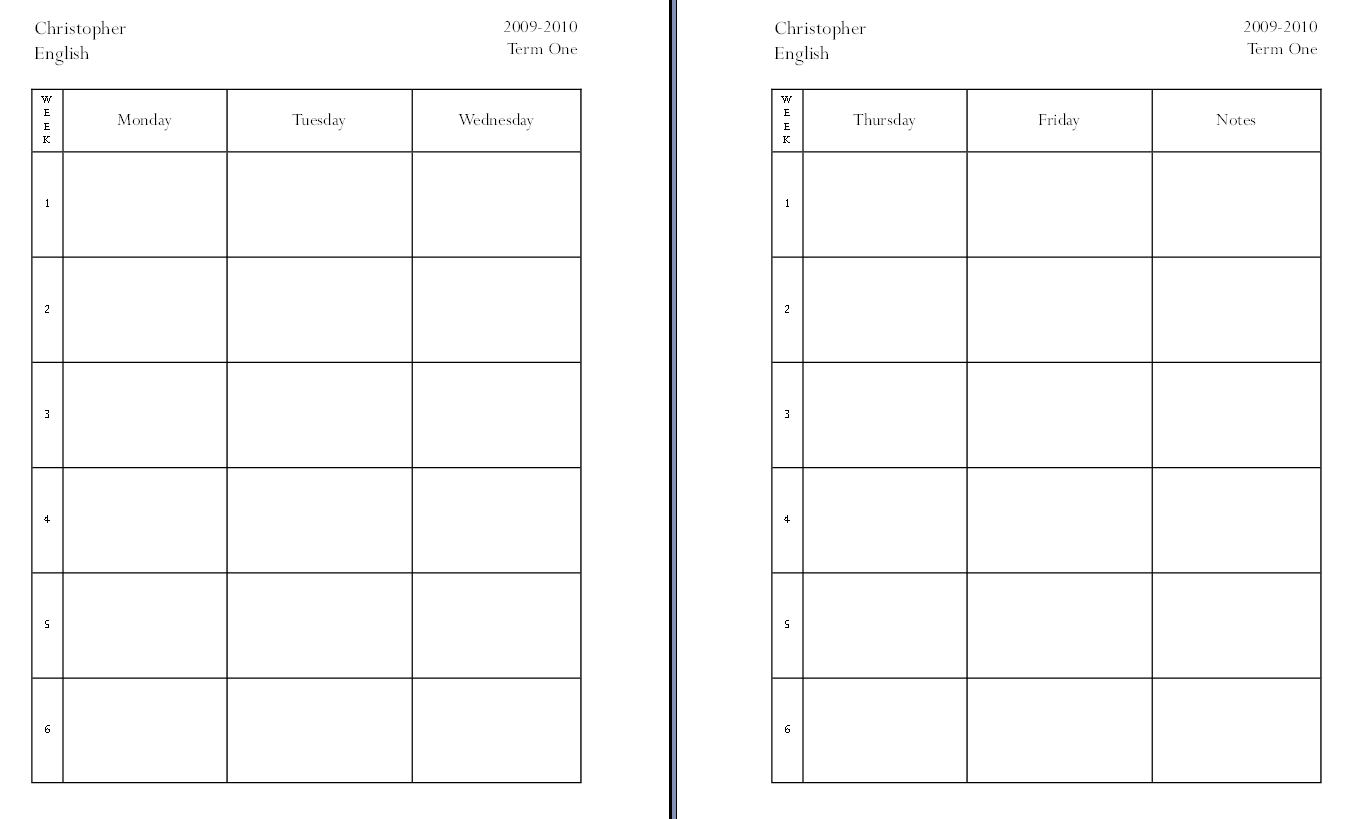
This shows a blank layout. Once I have them all printed I three hole punch them and put them in the binder, then I use these sheets to lay out the weekly plan for each subject. I start with post-its and pencil. Post-it planning is not my original idea and you can see a couple other examples here and here. In each square I write the pages and assignments (trips, readings, crafts, projects) for each day. The reason for using pencil and post-its is because I have to move things around a bit when it comes to putting things into the calendar to sync the four children’s lessons together. Those things that I am pretty certain will work on a specific day (like daily math and reading) get penciled. Post-its are for more time consuming or resource intensive parts, or things that will need to work with the other children’s lesson. So things like history and geography where I try to work with the children more as a group are put on post-its so I can move them easily.
Friday and I remember to do this thing!
Instead of thinking about it on like Monday afternoon.
My seven quick takes.
One
This was such a good movie. Kevin Bacon was perfect. The pacing was superb, the music and cinematography all gelled. But, I have no idea how to describe it. Both my husband (USMC himself) and I had tears in our eyes watching it. It isn’t a documentary, though it tells a real story that most people don’t see. It wasn’t about war, but it was about honor and the pride a country takes in her fallen. It was about loss and dignity and all that is best in our servicemen and woman and those who love them, those who lose them and those who care. I saw a quote from Chance Phelps father: “These kids join the Marine Corp to fight for the United States, but they die for their friends next to them.” Very good movie, thoughtful and soulful.
Two
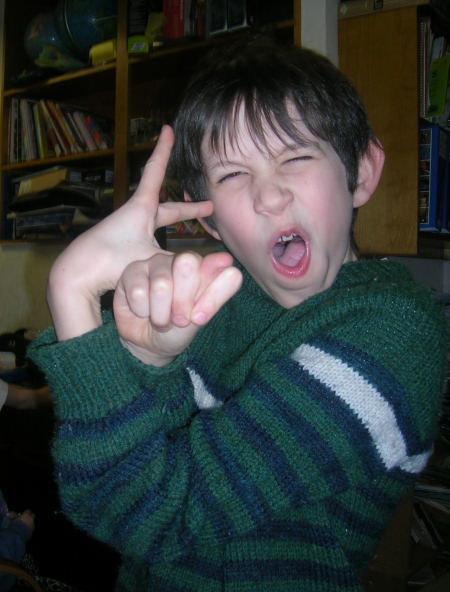
This kung-foo master is heading off on a summer adventure. Oregon, Nevada, California — with my parents. He will be seeing a bunch of interesting things and hitting Disneyland up before he heads home.
Three
This hymn is stuck in my head. (just the music I don’t think I have actually watched the whole video, and there is that shocking bit of discordance near the end… but finding a really good version of this is so hard.)
Four
This week has been a sew-tastic week. I made Ashley a new dress. She looks like she stepped out of a Jane Austin novel. Empire waste, sheer over skirt. It is a rich blue with black and silver lace ribbon trim. I get to dress her up once in a while still… right? Just because she turned 17 two weeks ago doesn’t mean I have to give that up.
Five
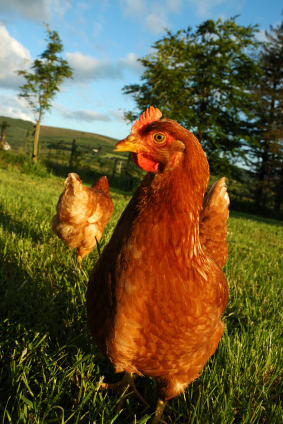
We are getting some chicken from a really nice family in our parish. I called the mom today to talk about getting them and she wanted to know if we wanted them live. She was sure the boys would get a kick out of butchering them. They probably would, but the thought of 6 live chickens in my mini-van — well the thought is hilarious the reality would probably feel like an afternoon on one of Virgil’s sight seeing tours of hell.
Six
I married a great guy
Seven

My dog has made an amazing recovery since we started feeding her cheep canned dog food. My dad recommended trying it and she is doing so much better. She put on weight, she is acting happier. yeah Alpo.
Homeschooling – Planning for next year – Reading Lists
Yesterday I listed out the texts that we are using for next year with the promise that I would return to our book lists in a future post. Today’s post is all about why we use “real” books, how we incorporate them into our educational plans and which books we use.

Literature:
When I was a child in school I remember reading from text books that excerpt short passages from “real” books or contained banal stories written with particular language lessons as the single driving force behind them – I loved to read; I hated reading as a subject. As I started looking into homeschooling I found that this “twaddle” reading was objected to by more than my childhood self. In fact several schools of educational thought out and out reject that approach outright. So, since it fits with my general inclination and is support by others in the field of education: we go for real books. Stories and books that are valued for their literary quality, cultural value, beauty and meaning, and their place in space and time are selected instead of stories that are selected or created for their mechanical purpose and functionality.
Exposing children to good literature develops their mind and imagination. It creates a frame work for them to incorporate big ideas, important values, virtue, liberality of thought and curiosity. Learning classic children’s tales also imparts the cultural literacy that will enrich their understanding of literature throughout their lives.
The real problem for us isn’t finding enough good books it is limiting the number to a manageable amount. One of my favorite lists can be found here. For each child we select books that fit their interests and their reading level. For independent readers I assign a set amount of reading per day (one chapter usually) the child is supposed to note any words that they are unfamiliar with. When they have completed the reading assignment they look up 3-5 of the words in the dictionary and type the definition into their reading log. They also compose a short synopsis of the day’s reading.
For the first term Christopher will be reading Tom Sawyer and The Hobbit for his literature study. Hannah will have The Courage of Sarah Noble, The Boxcar Children and A Bear Called Paddington.
We also have reading time. The children are free to select any book off the following lists to read for 30 minutes a day.
Christopher’s Book list:
Call of the Wild
Black Beauty
The Red Badge of Courage
Swiss Family Robinson
Last of the Mohicans
Story of King Arthur
Twenty Thousand Leagues Under the Sea
Robinson Crusoe
Kidnapped
Robin Hood
Lion, the Witch and the Wardrobe
or any classic he can talk me into.
Hannah is transitioning to independent reading so she can pretty much pull anything off the bookshelf that suits her fancy. I will develop a list for her for the second term. Josh and Sarah are still in the picture book stage.
We have read aloud time which is more directed to the younger children. This year we will start with Hedi, Peter Pan and the House at Pooh Corner. Once a week we will have a fairy tale story.
Shakespeare:
This is the first year for Christopher to be studying Shakespeare. I started thinking about this last summer when Ashley took a liking to Baz Luhrmann’s ‘Romeo + Juliet’. It was one of those moments where my mind slipped around juggling uptight catholic mom, literature loving me and introduce the children to great books teacher roles. The younger kids liked it to, but it is violent and sensual, but nothing really explicit, but it was very trendy looking and all that suicide and people dieing and sex… but how do I really get “Stop watching Shakespeare” out of my mouth without laughing myself silly. So I let them watch it. Which turned out fine. They liked it, they got the basic story without being scandalised and and it stuck, they can reference it in a meaningful way. So, Shakespeare it is.
I am going to start with Much Ado About Nothing. First off it is one of my very favorites, it is included in Edith Nesbit’s highly recommended work and I really enjoy Kenneth Branagh’s version on DVD, which I happen to already have, which I think is sort of an elemental point. Shakespeare is meant to be seen. Plays studied only by sitting in front of a book lose their form and much of their vitality. Which is why I would much rather have the children read a good story rendition based on the play, watch it using the language as written (which both Branagh and Luhrmann keep reasonably close to) and memorise some of the key passages. My hope is that this will be rich and entertaining for the children this year.
Poetry:
This year we will also be doing several poetry until studies. The poems we select will come from several different anthologies including: A Children’s Garden, my old Oxford Anthology of English Literature and Where the Sidewalk Ends, and A Child’s Anthology of Poetry.
Science:
Having looked in vain for a science text that I really liked I have decided to do something a little bit different. I purchased an older science text (from the 1980s oh-so-old) and I am using it’s table of context as more or less a “spine” for Physical Science. Along with this we will be studying biographies of important scientist. The first 12 weeks we will read about Aristotle, Galileo and Copernicus. I am still researching the specific biographies for this.
I wouldn’t take this direction if I wasn’t flat out obstinate about what I think is important in a science curriculum and arrogant enough to think that my college level course work in Chemistry and Physics is adequate to answer the questions of a 10 year old boy doing middle school science. But there it is.
Nature Study:
Learning about nature requires something more than just reading a text. I love nature journals. this fall the children will be working on cataloging the trees that grow around us. Identifying native species and common foreign species and learning through observation, cataloging and study. We are going to use a good field guide to native plants for most of this work.
Art and Music History:
This term we will not be doing any biographies in either art or music, but starting second term we will study one artist and one composer.
Homeschooling – Planning for next year – Books
Yesterday I blogged about the beginning of our homeschool plans for next year. Today I am going into more detail starting with the books and texts we are selecting.

First off, we decided against using an out of the box curriculum a couple of years ago. We had looked at a few of them, but we were having problems finding something that we really liked enough to devote ourselves to. And basically it boiled down to a few issues. I wanted faith to be a more or less integral part of the whole, but not a contrived part of it. We also had to find things that fit with the ages and interests of our children. Homeschooling is a way of life; it is not just another option. If you decide to homeschool it ends up affecting everything, in mostly very good ways, but everything is changed or at least colored by that choice to homeschool. When you select a curriculum that becomes part of your everyday life – every day. So we end up picking and choosing what we use from several different programs including Mater Amabilis (the biggest part), Ambleside, CHC, classical homeschooling and a big sampling of the wonderful things from the Real Learning forums.
After deciding the subjects we plan to study the next step is picking the texts, programs, etc. that we wish to use.
Religion: For religion we use the Faith and Life Series from Ignatius press. Our CCD classes use these books. Next year we will use Book 1


Math: Our math text of choice has been Singapore Math. We are considering switching Hannah to Saxon math, but if we do so it will be after the first 12 week term. For Term one we will have: Earlybird Kindergarten Math Textbook A and B , Singapore math 1B


English: We are using new texts for English for Hannah and Christopher. Hannah will use: Primary Language Lessons
Phonics: Our phonics instruction is based on the Writing Road to Reading

Literature and Reading: We do not use a reading text, instead we select actual books to read. I will make a separate post for the children’s reading lists. Our Shakespeare readings will come from: The Children’s Shakespeare

Writing: We use the Getty & Dubay Handwriting Series. This fall we will use Book B


American History: From Sea to Shining Sea
World History: Christopher will have The Story of Mankind

Science: The children’s science references will be Christopher: Encyclopedia of Science


Latin: Christopher’s Latin test will be:Cambridge Latin Course Unit 1

German: Christopher will start informal German studies with Berlitz German

Piano: Alfred’s Basic Piano Library

Other subjects do not have a particular text or reference. For some of them I wasn’t able to find exactly what I wanted and ended up cobbling together my own “text” for others we use reading lists or unit studies which I will describe in a future post. But the above list is pretty much it for texts.
Homeschooling – Planning for next year – Subjects
Summer is just beginning and so has the work of planning next year’s studies for the children. It isn’t really work – though it can be rather time consuming – it is fun. There is something really exciting about going through all your supplies, perusing the web, reading through the catalogs and deciding on those things that you hope will spark your children’s excitement and wonder. This is all restrained by the realities of budget and time, but the initial planning phase is such a hopeful time.

This year I am doing a bit more formal lesson planning. I am breaking the year into three 12 week periods. Our calendar runs Term 1: September 7 – November 20 (one week off for Thanksgiving) then November 30 – December 4 then off for Christmas. Term 2: January 4 – March 22 one week then off for Easter. Term 3: April 5 – June 25 then off again for summer. I am working on creating the master “lesson plans” for the first term for each child. I created planning pages using MS Publisher – I print them out blank and then use pencil and post-it notes to fill in the plans until they are were I like them.
Christopher will be starting his first year of “middle school” studies. Approximately 6th grade work. Hannah will be doing early elementary school work, about the third grade level and Josh will be starting with grammar stage- first grade work. Sarah will begin some formal work, mostly pre-kindergarten stuff.
Christopher’s subjects will be: Religion, Math (pre-algebra), English, Literature (classic literature, and an introduction to Shakespeare), Writing (penmanship and composition), American History, World History, Geography and Cultures, Science (physical science and nature journal) Latin (beginning formal study), Art and Music History, Art (drawing and watercolor), Music (piano) and German (informal introduction).
Hannah’s subjects will be: Religion, Math, English (grammar), Reading, Writing (penmanship and copy work), American History, Geography and Cultures, Science (earth science and nature journal), Latin (informal), Art (drawing and watercolor), and Music (piano)
Josh’s subjects will be: Religion, Math, Phonics, Reading, Writing (penmanship), Geography and Cultures, Science (earth science and nature journal), Latin (informal), Art (drawing and watercolor), and Music (piano)
Sarah will have: Religion, pre-K Math, Letter Recognition, Arts and Crafts, World Cultures, Nature Discoveries, and Music (songs)
Raising prolife children — part two

This is the second part of this post. The first part is here.
Raising Prolife Children
Our children live in a world that is often hostile to Catholic teaching and moral thought. While roughly half the people in this country are at least nominally “pro-life” the media and especially the cultural and educational institutions of this country tend very much to the “pro-choice” side. One of the jobs of Catholic parent’s is to equip our children to go out into the world and be able to defend their faith.The earlier we start preparing our children for this the better.
The early years – Where do babies come from?
What is the first thing you can do to help your child become firmly prolife? Save your child’s ultrasound picture. Fetal development is the first and best tool in the pro-life arsenal. While your child is still a preschooler you can teach them the very basics of “babies”.
- Follow a real pregnancy week by week. – It is most helpful if you can connect this information to a baby they will know. When a sibling is expected, or a cousin or a friend’s baby – as long as they will see the pregnancy develop and the baby grow. A child who follows a pregnancy like this is forever connected to the idea that babies begin growing in their “mommy’s tummy” and that this growth process is an uninterrupted line through childhood. When I am expecting we have used common objects like raisins, apple seeds or pin heads about the baby’s size. Never, ever avoid the reality of pregnancy – no storks or cabbage patches. Babies don’t suddenly appear at the hospital to be brought home.
- You can use real pictures of fetal development from the internet to learn about the growth of the unborn child. Talk about the pictures, even the weird looking little fetus with arm buds and tails and remind the children often that all people, even they, went through these stages too. My children have found it amazingly wonderful that once upon a time they had a tail. Show them the picture from their ultra-sound, “this was you when you were in my tummy.” Nothing is more powerful than connecting with the unborn child they once were.
- Read books about developing babies. There are many good options, Angel in the Waters which tells the story of a baby and the baby’s guardian angel and is particularly Catholic, but there are more options. Checking out the local library is likely to yield a ton of results that you will find appropriate.
- Pray for babies yet to be born and the mommies and daddies and families waiting for them. You know you are praying for all those women this very day facing an unexpected and alarming pregnancy, those women struggling with the decision to abort or not; your children know that they are praying for all mommies to be happy and healthy while their little, tiny babies grow inside.
As children grow
Growing up in a family committed to the culture of life one of the strongest witness any child could have for the rightness of the pro-life movement. All too often the arguments for the “pro-choice” stance are actually arguments against false characterizations of those who are pro-life. The claim is un-apologetically laid that those who are against legalized, uncontrolled and elective abortion are only concerned about the welfare of the unborn at the expense of all others. This spurious argument is easily bared to be the lie it is when one looks at the lives of most pro-life proponents. We need to live as part of the culture of life.
- Offer help for mother’s in need. Support your local crisis pregnancy center. Donate toys, clothing, diaper… what ever they need. Include your children in these activist. Take part (or organize) parish fund-raising for pro-life causes, both the alternatives to abortion locally and help for the poor and needy, especially woman and children, world wide. While it is appropriate to teach our children chastity and to never glamorize unwed pregnancy, crisis pregnancy support saves lives. Showing an example of mercy is undoubtedly a good. As children mature we can discuss the disadvantages (both moral and practical) of single motherhood and intercourse before marriage, but mercy to those in need does not need to be suspended because we are blessed enough to know there is a better way.
- Honor the lives of all. My children have the advantage of having a sister with a severe disability. They see day in and out the struggles and the blessings both of being a family touched by disability and of those living with disability. My oldest has reached the age where she occasionally confronts someone advocating abortion of the disabled. This rightly sets her into a fit of indignation – the person thus advocating is speaking about her beautiful sister. While she could not and would never diminish the struggles she also knows first hand the blessings. We absolutely have to teach our children that having a disability is not a frightening, horrific thing. Support your parish families with disabled members.
Volunteer at the Special Olympics and other organizations that help the disabled. Some schools have “peer” programs where normally developing children are paired with children with learning disabilities to assist them in their social development.At the very least never show fear or hesitation around a disabled person. Treat them exactly as you would anyone else.
As an example: Several years ago one of my online friends confronted, first hand, the bias against the disabled in our society. Her husband’s brother and sister-in-law had died in a car wreck, leaving my friend and her husband in custody of their niece and nephew. The deceased couple had adopted a boy with spina bifida and then a little girl with autism. The boy was nine, had just lost his parents, moved across country to live with his aunt and uncle. While his aunt was enrolling him in the third grade class at a private school (regular academic) another mother saw his leg braces and said with contempt, “Oh, we are enrolling these kids now?” Apparently everyone in the office was too slack jawed at the woman’s rudeness to come up with an appropriate response. I am afraid my own would have been less than ideal. As can be imagined the hurt the boy experienced was very, very real. While this one woman’s response was extreme their are many who would have thought the same, but wisely held their tongues. There is a ever growing part of our culture that views those with disabilities as “burdens”; at best tragedies for their families and drains on the “system” and better for everyone if aborted. (for further evidence of this topic note some of treatment of Sarah Palin over her son Trig) We have to fight this mindset tooth and nail.
On the other end of life my children have had the opportunity to see my grandmother age. She is 85 and lives near us. They love Granny and see her as valuable and worthwhile. Even as she suffers from the affects of age and dementia. Do not be afraid to bring the elderly into your child’s life. Age is not something to fear; we are only stepping closer to Heaven and honoring and loving our aged relatives sets the example of families caring for their own with love and compassion instead of shifting this duty and (at time) a burden onto the state – which has neither love nor compassion.
- Pray for those who are suffering, the poor, the sick and dieing. Pray for a softening of the hearts so that people who are different won’t be discriminated against.
- I am not sure when is the most appropriate time to introduce the concept of abortion to children. My own children have grown up in parishes that aren’t afraid to pray for an end to abortion and they hear Catholic radio in the background with “pro-life moments”. So they hear the term and eventually they ask the question: “What is abortion.” Three of my children asked at around age five. My own mind revolts at not being truthful with my children, so my response has been something along the lines of “Abortion is when a mother is pregnant and doesn’t want her baby so she has the baby killed before it can be born”. I am sure there that some people who would object to that description as too harsh.
I actually thought about it for a long while before I came up with it. First I wanted the explanation to be short, honest and “horrific” in a way. I wanted it to be slightly shocking, because abortion is shocking. I use the word “mother” instead of “woman” because mother implies a responsibility for the child. I didn’t say “she has a doctor kill the baby” or “she goes to a clinic and they kill the baby” because I didn’t want my children to associate doctors with killing babies and I didn’t want to go into the questions of “what is a clinic”. I also wanted the word “killed” in there so there was no confusion on that. The above explanation is also open enough to invite questions. My Josh’s first question was “Why would someone do that?” and it led to some discussion about the reasons why some woman feel that is the best thing to do, but how horrible it is and how selfish it is.
My own experience and the insight I have seen talking to other parents and friends is that the way abortion is first introduced colors the way a person views abortion on a profound level. If your very first introduction to abortions is something like “Abortion is when a woman finds out she is pregnant but it isn’t the right time for her to be a mother so she goes to the doctor and the doctor ends the pregnancy before a baby can grow.” and your first introduction to the concept of pro-life is “some people think that abortion is wrong so they want to force a woman to have a baby even if she know that is the wrong thing for her.” your perception of abortion is focused on the poor woman forced to have a baby. If your first introduction to abortion is about the murder of the child and how those who are pro-life are trying to make it safe for all babies waiting to be born than the paradigm shifts. If you view abortion through the lens of the woman’s “rights” it is difficult to consider the child; if you view abortion through the lens of the baby’s right to life it is almost impossible to not be pro-life (though I have known a few people who managed it).
Racism and Homeschooling
Over at Bendng the Twigs I found a pair of posts refuting the idea that a common motivation for homeschooling is racism.

Usually I miss the hotly controversial postings about homeschooling until they are well past their expiration date, but this one I almost made it in time for. Apparently Jesse Scaccia, a teacher, has put his ‘well honed’ mind to the test and was able to come up with ten reasons that homeschooling is bad. His list boils down to: homeschool children are weird, homeschool parents are arrogant, selfish and isolationist, homes are not schools, Mr Scaccia has some sort of personal issue with homeschooling and apparently the Great Commission requires sending our impressionable offspring to schools that weren’t even in existence in the first century. I count five reasons there, but I don’t judge Mr Scaccia too harshly on his math problem; he is an English teacher not a math (or biology) teacher.
I am not overly interested in dissecting Mr Scaccia’s opinion except as it is related to the issue that homeschoolers are somehow more isolated culturally than schooled children and that this could in some way create citizens who are bigoted. To quote:
“4. Homeschooling could breed intolerance, and maybe even racism. Unless the student is being homeschooled at the MTV Real World house, there’s probably only one race/sexuality/background in the room. How can a young person learn to appreciate other cultures if he or she doesn’t live among them?
3. And don’t give me this “they still participate in activities with public school kids” garbage. Socialization in our grand multi-cultural experiment we call America is a process that takes more than an hour a day, a few times a week. Homeschooling, undoubtedly, leaves the child unprepared socially.”
Being socially isolated and culturally backwards I have no idea what MTV Real World house is, but considering it is MTV I am comfortable making a guess that more often than not it wouldn’t be a great environment in which to raise a child to be anything remotely resembling a cultured and liberal minded person. But let’s answer Mr Scaccia’s question: How can a young person learn to appreciate other cultures if he or she doesn’t live among them?

I have never lived among the Maasai of Kenya and Tanzania, but I do appreciate their culture. I could say the same about the Japanese or the Spartans of Ancient Greece. Other groups I have some first hand experience with: Members of the Modoc tribe of Southern Oregon and Northern California were family friends in my childhood. I have lived among African-Americans and Choctaw tribal members in the South and the next street over from Orthodox Jews in Boston and at the same time one apartment down from a family from Lebanon – the second wife was a particular friend. I have traveled in Mexico, Germany, France and Austria and brought home an appreciation of these countries’ art, music, culture and food. But none of these experiences were gained inside the walls of a traditional school — not a single one of them.
While I won’t deny that there may be some parents who homeschool their children with the hope of insulating them from other cultures and peoples 0r who, even worse, homeschool them in the hopes of indoctrinating them into a belief that their race is superior to others; such parents are the minority. They are a minuscule group defined by an ideology of fear, fear of blacks, fear of whites, fear of anyone who doesn’t agree with their world-view, but they do not represent homeschoolers at large. But, to quote Jefferson again: “It is better to tolerate the rare instance of a parent refusing to let his child be educated, than to shock the common feelings and ideas by the forcible transportation and education of the infant against the will of the father” Even if a very few wacky parents wish to teach their children thus it is not an argument against homeschooling. It is at most an argument against parents being wacko, but since that is rather impossible to avoid (public school or not) the point is moot.
But turning again to the question at hand I realize that my personal experience will most likely be met with “Yes, but that is just your personal experience, how are most parents going to manage that?” Let me answer that obvious objection by talking about my personal experience a little more in depth.
 Simply Catholic