Autism · Catholic stuff · rants

“I can’t discipline him out of his autism”

If you have come here today because of the Adam Race story and are looking for other information about autism and Catholic life I have two other articles you might be interested in:

Can My Autistic Child Recieve Communion
Autism and Catholic Life


image of St. Dymphna,
patroness of  nervous system disorders

“I can’t discipline him out of his autism”, said Carol Race, the mother of an autistic teen boy.  She feels her priest expects that she should be able to do so.   I suppose that is possible it is what the priest is thinking, it could also be that he is simply at the end of what his parish can reasonably accommodate.  The Race’s have been attending the same parish since 1996 with their five children and now the family has a restraining order against them to keep them from bringing their six foot tall, 225+ lb, 13 year-old son to mass.

The Star Tribune in Minneapolis & St Paul, MN has two articles on this story.  I would like praise the authors of the articles for the fair and balanced way they handled the stories.  While the headlines: Church bars severely autistic boy from mass and  After warning, family of autistic teen attends different churchdefinately are there to draw attention the articles themselves tell the story in an even handed way that I am unaccustomed to seeing in the main stream media when it reports on anything having to do with the Catholic Church.  Reporters Pam Louwagie, Curt Brown and Laura Pabst could have talked to the parents and the disability community advocate/activists folks and come away with some screed about the horrible Catholic Priest who won’t let this poor family come to mass.  Which would have been much more sensational and not true and with the tragic effect of putting in the minds of parents with autistic children that the church doesn’t want them… which is also very much not true.

A careful reading of both articles paints a sadly familiar story.  This family has been attending mass in the same parish since their teen was a baby.  Week in and week out with their five children, drawing strength from the Mass, their faith and community.  In 2005 Carol was given an award by the Diocese of St. Cloud “for her efforts to encourage families with disabled children to attend mass” and even in this current situation she says, “The church isn’t bad. But it’s what some individuals do within the church” and that she hopes this doesn’t reflect badly on the church as a whole.

I feel very badly for this family.  The articles talk about how their son, Adam, gets something out of the mass.  That he responds to the ritual and the routine.  I can attest with my own daughter how true that can be, how calming and wonderfully spiritual mass can be to someone with autism spectrum disorders.  But I suspect the parent’s are not being completly objective.

Their current priest has been serving in this parish for three years; last June he went to visit the parents.  There were concerns with their son’s behavior.  The parish says it offered services through Catholic Education Ministries and Caritas Family Services which the parents refused, that they eventually offered mediation to convince the family not to bring their son to mass and finally had to use a restraining order.   Why would a parish that has been serving this family for over a decade suddenly go from welcoming them to getting a restraining order in the course of a year?

The affidavit filed by the parish states that Adam would spit (his parents claim he made spitting faces), that he urinated in the church (the parents agree he is sometimes incontinence), that he hit a child, that he knocked over elderly pairshioners as he blotted from the mass (mom and dad claim he bumped into them), and on Easter he ran out into the parking lot and started their family car then got into another car and revved the engine (the parents say he is drawn to engines).   The diocese says the restraining order was a last resort, the parents are understandably upset, and the advocacy person, Brad Trahanm (RT Autism Awareness Foundation)  proclaims “It’s unfathomable and concerns me that we’ve taken a situation with special needs and we’re making it into the criminal matter. ”

It is obvious that there is a lot of disconnect here.  The parish sees things one way and the parents an other.  The news reports this as though it were a straight forward two party disagreement, but it isn’t at all.  On one had there are the parents.  They obviously feel serious enough about their faith to attend mass every week (presumably) with a severely autistic child.  And not just that, but they have helped other parents of disabled children by encouraging them to take part in the Mass and their parish’s community life.  Mass is important to the family.  When you are taking a child to mass and you sit in the back pew or the cry room because you know your kid might well have a disruptive meltdown, you bring cloth restraints, you leave during that last hymn to “avoid interacting with other parishioners on the way out” and you sit on your child to calm him — you have a problem, obviously, but that also speaks of a great deal of dedication.  It is terribly unfair to ask this family not to come to mass.

The priest has a responsibility to serve his entire community and I suspect he has heard a lot about the situation from other parishioners.  If parent’s of small children are worried about taking their toddlers into the cry room because there is a boy as big as a man having a meltdown in there, or if an elderly parishioner is afraid to get to close to the kid because he might get knocked down, or you have a teenage boy who “once pulled an adolescent girl — an exchange student staying with the family — on top of him, grabbing her thighs and buttocks” in Mass — the priest is going to be expected, by the entire congregation, to do something.  That something is not going to be to “educate” the community on autism to explain away things like spitting, urinating and running out into the parking lot to rev up the engine of another parishioner’s car.   It is terribly unfair to ask the entire parish to come to mass and have to worry about what Adam will do next.

Then there is the larger community of people with disabilities and their families.  We need to have access to the Sacarments just like any other family.  Already there are too many families not attending mass with their child with emotional disabilities for fear of what others will think.  In the news article another parent, Tim Kasemodel, asks “What are we supposed to do, literally lock our kids away so no one has to see this for the rest of their lives?”   There are a lot of autistic children out there and we will see more and more of these kinds of situations as they grow and hit puberty.  The Church needs to be able to address our families’ needs in a substantive way.

As sad as it is, as much as I hate saying it, the priest seems to be in the right in this situation.  He has the responsibility to make sure that every parishioner can attend mass and feel safe.  While small noises and even a very occasional out burst are acceptable and understandable it sounds like Adam’s situation is beyond that — and perhaps it is of note that a judge agreed.   The boy is big, intimidating and from everything in the article, even the parents’ own statements, they can barely control him.  They have been lucky so far.  Adam could have put the car in gear and killed someone, he could have knocked over an elderly person and seriously injured them, the parents of the child he hit could have filed assault charges.

Puberty and autism can be a cruel mix.  The added size as the young person approaches adulthood, the hormonal changes that can lead to mood changes and aggression, plus the lack of impulse control and the lack of empathy so common with autism can create a situation that is very dangerous.  The child is almost over night large enough to do real harm, unpredictable and sometimes aggressive, with no impulse control and no understanding they they can hurt others, or even that others can be hurt.   I have been there and lived this.  Our family made the very difficult choice to place our daughter in residential care when she became physically aggressive with her younger siblings.  I know other families have faced a similar situation and made the same choice and still others who have managed to deal with their child’s behaviors in home.  Every situation is different, but my guess is that about a year ago Adam Race’s hormonal changes and growth made his attendance at the mass his family had been taking part in for 12 years too difficult for the parish community to manage.

I wish there was a good solution that would allow the family to bring Adam to mass.  But I am afraid that it is in the end asking too much of the community.  I doubt that any amount of education about autism would make a frail, elderly man feel safe if he sees six foot Adam bloting his direction.  I don’t think there would ever be enough explanation that would make a mother comfortable taking her toddler to the cry room if the Races were there with their son in flannel restraints, even if the restraints are calming to Adam.   So does the old man fear if he has to use the restroom that he might be knocked over on the way?  Does the young mother have to miss part of mass because she can’t use the room that was designed to allow her to comfort her fussy baby and still be in attendance? 

I have often observed that the cruelest thing about our daughter Rachel’s autism is how her behaviors make her world smaller.  She can’t go camping like other kids, she can’t go to sleep overs, she misses a lot.  I hope that the Race family can find some solutions that work for them and for their parish.  Perhaps they can alternate masses between the parents so one can stay home with Adam, maybe they can find a special needs mass that would work better for them, maybe they can take Adam to a week day mass.  It is sad and unfair that Adam can’t attend mass with his family as they have been accustomed to, but it would also be unfair to ask the entire parish to have to attend mass in the situation describe in the news articles.  This is one of those times where life is just unfair.

(I originally posted this yesterday, but a lot of incoming links have been coming to this post so I am bumping it to the top)


 

Autism · rants

A little more about Adam Race

Adam Race is the young autistic man in Bertha, Minn.  

The Church of St. Joseph in Bertha, Minn., filed a temporary restraining order barring Carol and John Race from bringing their 225-pound son, Adam, to church. An affidavit alleges Adam struck a child during mass, fought efforts to restrain him, pulled an adolescent girl to his lap and revved the engine of someone else’s car. A parish statement said the legal move was a last resort after church leaders tried to accommodate and mediate, but the family refused.

On Monday, after her court hearing was delayed until early June, Carol Race spent the day lining up legal help and giving interviews to national media.

*****

Update:

My latest update on this story is here.

It is funny how quickly thoughs and feelings can change.  While I disagree with Carol Race’s actions regaurding the media her own words about her situation are worth more than mine. 

If for some odd reason you really want my thoughts on the whole situation they are much better expressed here.

******

This is difficult and sad on so many levels, but lining up new interviews is not going to resolve the issue for her family.  My sense is that the Diocese of St Cloud would have never gone forward with a restraining order without knowing pretty solidly that they had a good case if it goes to court once it was violated.  Anyone with half a brain would see that this would be very bad publicity if it got out of hand.  All of that together makes me think that the situation in the parish had gotten very bad and the priest had exhausted all options.  I pray that this can all work out for the best for Adam, his family and the parish.

(Yes, I have serriously edited this post.  I was angry when I first wrote it, not just at Mrs. Race, but also at the media and how they have turned this into a “faith” issue when it is really not.)

rants

What can you do with 1/4 a yard of fabric?

Make a prom dress!

A Houston teen couldn’t get into her prom because her dress was scandalous (CNN Video) and then got herself cuffed when the police were called because she started demanding her money back (I read that as making a royal scene in the hotel lobby)  The dress, besides being hideous covered about as much skin as a two piece swimsuit and was completely  inappropriate for a high school prom.  The countdown for the inevitable lawsuit has begun.


This is more my style.

I went to two proms and seriously they are so over-rated to begin with.   But to get the cops called on you because you insist on wearing the latest “Almost a dress” to a school function says a great deal.  It is just astounding.

rants · Uncategorized

Defining art

A couple of stories have attracted my attention the past few weeks.  One was that poor, silly woman from Yale who apparently (or not) tried to impregnate herself as often as possible, then took some sort of herbal abortificant (not really) and filmed herself aborting (or menstruating) and then wanted to combine that with plastic wrap and something or other and this was supposed to be displayed as a medium for inciting conversation about the relationship between the female body esthetically and functionally or something like that.   Because women and reproduction is such a very neglected discussion point in our society.   She succeeded in grossing out a lot of people and really getting Yale very up-tight.  But is that “art”?

Then there is some fellow who got a dog off the street (or hired some kids to find one) then took it to an art gallery where it was tied up and allowed to die (or not) and the artist laid out the cryptic message “you are what you read” in dog biscuits were the dog died (or not – the stories keep changing to fast to keep up).  Maybe we are supposed to see ourselves as the dog biscuits? Or maybe this is some commentary on animal cruelty and the absolute irony of modern society. A lot of people got upset and it looks like the “artist” is going to perform his art again… because it is art.  Isn’t it?

Really, if either of the above things count as art I must be completely mad.  I love good art.  I spent a lot of time in the BMFA in college and I loved my art history classes.  I love a lot of the new art coming out, the classical revival work is really exciting to me.   I love music and poetry and theater and visual art in all its many forms.  Art has shaped and enlighten my thoughts and enriched my life in innumerable ways.  That is the main reason that I really wish that the “art” community would stop treating this juvenile, sadistic, duncical, low-class, gutter obsessed, attention whoring,  offensive, drek as art.  It is not.

It is not art in the same way my child throwing a temper tantrum is not negotiation.  Art, as it is arguably defined in some college classes I have attended, is designed to make you think. Maybe something that challenges the viewer.  (At that point it usually collapses into verbal garbage about the deep, challenging, thought provoking thing that is the insulting, argumentative and usually down right disgusting excuse for modern de-constructed art).  These types of exhibitions can at best be called performances.  What they actually seem to be is rather pathetic screaming fits thrust into what should be the rational discourse of public ideas.  When what you do is so offensive that it ceases to be thought provoking and becomes merely provoking, it ceases to be about the ideas and becomes about the “artist”.

What these forms of performance art most represent is a break down of discourse in the public sphere.  Everyone has an opinion and every opinion must be expressed but the only opinions that count are the ones that get 15-minutes of fame.  They make the news, hit the top of Goggle and technorati, they scream really loudly for a few seconds and then are gone, replaced by then next wacko with an opinion that they want to shock the world into thinking about. Instant attention doesn’t equal fame, and even fame doesn’t equal any sort of gravitias, it just means that you are the one in the spotlight this second.   These pathetic attention stunts excused with the misbegotten title of art are more like those silly game shows where the audience dresses up in outrageous costumes so the camera will pan over them for a moment than they are any type of serious discourse on important topics.     They don’t even serve their stated purpose of getting people to discuss the ideas they are supposed to be about all they do is create offense and outrage usually directed towards the artist and/or the institution they are sponsored by.

In normal society when someone starts raving and offends those they are with they soon find themselves excluded and unwelcome.  The same should happen to this crass form of expression called performance art.  We, as a society, have to refuse to call this art and start calling it what it is.  It might be self-absorbed, pathetic, disgusting attention whoring.  It might be cruel, sadistic, attention-whoring, but it isn’t art.

My world · rants · Simplicity

If you want to save the earth…

Every once in awhile I read something that makes me outright chuckle.  Last night I was sort of surfing around and I found a little gem.  “You want to save the earth? Here’s a little hint. Don’t. Buy. Shit.”   It was tucked away in an article over at Pajamas Media; Desperate (Green) Housewives.  The article is a response to another at the New York Times which more or less takes a sarcastic look at the antics of suburban mothers consumed with “ecoanxiety” who  are doing little things and spending lots of money to make the bad feelings go away.  Laura McKenna takes the game a little further and points out the erratic hypocrisy of that particular style of “hip” green living in general.  

I really had to laugh at the whole thing.  What are those bad feelings called?  You know the ones you get when you realise that your 4000 square foot house that is home to four people creates a huge tax on resources, not to mention all the stuff that it is filled with?  The favored phrase is “ecoanxiety”, of course, anxiety is something that sounds treatable, pop a pill and relieve your anxiety, treat that symptom, get over it.  It is a term coined to express an interior reality, a trick of the mind, a feeling that is rooted in mindset, something you should be able to just get over.  If you call it what it really is, if you dare speak the word “guilt” then you create an external reality.  With guilt there is something real wrong, something you must correct.  There is no quick pill to take,  you must repent to fix what you are doing.   Guilt supposes a moral judgement. 

If you feel guilty because your lifestyle is consuming more resources than is equitable than that is where you should start, your lifestyle.  All those little pacifying “baby steps” might be better than nothing and they might make the “Green Moms” feel better, but the root problem, the core issue is left untouched. 

Blogs I Know · rants · Uncategorized

A thin line

There is at times a thin line between what is right and what is wrong. As Catholics we have centuries of moral theology, direction, logic, scripture, tradition and the living breathing magisterial teaching to guide us in navigating even the most baffling questions and sometimes we still have to pick carefully through the jetsam that whirls around us as science presses ahead with the question of “can we” often trumping the more important “should we”.   A few months ago several friends and I were commenting that as we age we find ourselves more and more accenting to the Church’s judgement on issues of moral teaching and dogma even when we are not intellectually convinced.  All out us have grown tired of inevitably being proven wrong in the long run.   We had each had an issue at one point with Church teaching.  We had, all being educated and sensible creatures, put our minds to work and begun researching the Church’s teaching on our issue thinking certainly we would prove ourselves right, only to slowly become convinced that we were actually wrong and the Church was right all along.

But I have also seen the opposite happen.  Where someone would be so very, very certain that they were right that they couldn’t accept the reality that they could be wrong.  To my mind the most honest thing for a person in such a position to do is to say, “Oh, well this can’t be right and if the Catholic Church says this then I can’t be Catholic.”  and to quietly, or even raving, angry and nailing their complaints to the Cathedral door, walk away.   Of course it is obvious that a good number of people don’t agree.  Some even stick around and they either want to “update” the Church or they try to be more Catholic than the Pope.

The more Catholic than the Pope people bother me far worse than those who run left of center.   They confuse not only loyal Catholics but those outside the church who stumble into their rants and confuse their lay organisations with the magisterial Church.   You don’t see the media picking up “We Are Church” too often and confusing them for the Catholic Church… you do see them getting  Bill Donohue and the Catholic League mixed up with the See and read headlines about Catholics calling for a boycott only to find out it is not the church at large, but a lay organisation.  Somewhat akin to claiming that “Ohio sees massive crop failures” based on a single farm loosing its corn and potatoes. 

These thoughts were brought firmly to mind last night while reading over at  Confessions of a CF Husband where someone had posted a link (now deleted) to some crack pot with an MD behind his name and rosaries on his blog claiming that the medical profession vivisects people in order to harvest their organs for transplants.  He goes to great lengths to point out the sections in the catechism addressing organ donation and the papal edicts to the medical community addressing end of life issues… and the does his best to apologize around them.  “Brain death” is viewed as too vague, irreversible is somehow beyond his ability to grasp.  What truly shocked me was finding this Dr. had also writing in other more trustworthy Catholic sources.  His doubts and ideas presented there seemed much more reasonable, but placeing these issues in a light far more delicate and confusing than they need be. 

The simple straight forward facts are that the CCC views organ donations as a good as long as there is consent and for postmortem donations that a mortem is reality.

2296 Organ transplants are in conformity with the moral law if the physical and psychological dangers and risks to the donor are proportionate to the good sought for the recipient. Organ donation after death is a noble and meritorious act and is to be encouraged as a expression of generous solidarity. It is not morally acceptable if the donor or his proxy has not given explicit consent. Moreover, it is not morally admissible to bring about the disabling mutilation or death of a human being, even in order to delay the death of other persons.

————————- 

Donation and transplanting of organs

83. The progress and spread of transplant medicine and surgery nowadays makes possible treatment and cure for many illnesses which, up to a short time ago, could only lead to death or, at best, a painful and limited existence.[175] This “service to life,”[176] which the donation and transplant of organs represents, shows its moral value and legitimizes medical practice. There are, however, some conditions which must be observed, particularly those regarding donors and the organs donated and implanted. Every organ or human tissue transplant requires an explant which in some way impairs the corporeal integrity of the donor

85. <Homoplastic transplants>, in which the transplant is taken from a person of the same species as the recipient, are legitimized by the principle of solidarity which joins human beings, and by charity which prompts one to give to suffering brothers and sisters.[177] “With the advent of organ transplants, begun with blood transfusions, human persons have found a way to give part of themselves, of their blood and of their bodies, so that others may continue to live. Thanks to science and to professional training and the dedication of doctors and health care workers…new and wonderful challenges are emerging. We are challenged to love our neighbor in new ways; in evangelical terms—to love ‘even unto the end’ (Jn 13:1), even if within certain limits which cannot be transgressed, limits placed by human nature itself.”[178]

In homoplastic transplants, organs may be taken either from a living donor or from a corpse.

86. In the first case the removal is legitimate provided it is a question of organs of which the explant would not constitute a serious and irreparable impairment for the donor. “One can donate only what he can deprive himself of without serious danger to his life or personal identity, and for a just and proportionate reason.”[179]

87. In the second case we are no longer concerned with a living person but a corpse. This must always be respected as a human corpse, but it no longer has the dignity of a subject and the end value of a living person. “A corpse is no longer, in the proper sense of the term, a subject of rights, because it is deprived of personality, which alone can be the subject of rights.” Hence, “to put it to useful purposes, morally blameless and even noble” is a decision “not be condemned but to be positively justified.”[180]

There must be certainty, however, that it is a corpse, to ensure that the removal of organs does not cause or even hasten death. The removal of organs from a corpse is legitimate when the certain death of the donor has been ascertained. Hence the duty of “taking steps to ensure that a corpse is not considered and treated as such before death has been duly verified.”[181]

In order that a person be considered a corpse, it is enough that cerebral death of the donor be ascertained, which consists in the “irreversible cessation of all cerebral activity.” When total cerebral death is verified with certainty, that is, after the required tests, it is licit to remove organs and also to surrogate organic functions artificially in order to keep the organs alive with a view to a transplant.[182]

The Church is, and rightly so, against many things such as fetal tissue research, IVF, abortion,  euthanasia and cloning.  These things violate the sanctity of life.  They reduce the human person in one way or another almost always with an eye toward utility.  They remove barriers that shouldn’t be taken away because then end results are ghastly for us all.  But organ and tissue donations do not fall into that category.  Far from devaluing life they elevate life, both the life of the donor and the life of the recipient as long as those few critical aspects are giving their full weight and importance.

Morally one life can not be shortened to save another.  Not matter how hopeless the case is, no matter how desperate the need.  Those aspects of the human body that are the seats of individuality, the reproductive and cognitive aspects, can not be transplanted.  There must be full consent on the part of the donor and/or their proxy.  When these issues are met then organ donation is a moral good, a postmortem act of generosity that extends the gifts of life and health to a fellow person.  This is a beautiful and honorable thing.

Where Dr (who’s-name-I-won’t-mention) goes floundering is in his conviction that people aren’t really dead when brain function ceases.  He even goes so far as to toss out his anecdotal proofs in cases where someone was “brain dead” and then came back.  I know God can work miracles, but moral theology and medical science do not base general practice on miracle cases.  In general if your heart will stop beating and your lungs will stop breathing with out mechanical support and your brain show no functioning then you are dead.  Lazarus was brought to life after three days, but organs sitting in a morgue for three days would be useless to everyone. 

Trying to frighten people off of organ donation by telling grisly tales of someone being cut open while still alive and feeling is reprehensible.  How many people out of fear for themselves or a love one would hesitate at that critical moment and say “no.”  Almost as bad is mixing the pot to confusion, talking about “persistent vegetate state”  a term heard frequently in the tragic Teri Schrivo case leading to the idea that organ “harvesting” might occur when the donor was capable of breath and circulation on their own.  Assertion that the papal documents are vauge  when they are only vague to someone determined to obscure them adds confusion that might keep a Catholic wanting to do good from signing an organ donor card. All this while quoting a dozen Popes and the catechism itself to prove the agendized point that organ donation is wrong in direct contradiction to what the documents actually say.

When the only thing that is keeping my heart beating or my lungs moving is something plugged into the wall… go ahead, turn it off.  In fact take any usable part of me and give it to some other person who needs it.  I feel quite comfortable that the magisterial Church would laud that choice.

Catholic Homeschooling · My world · rants

Nature Journals

Yesterday we took a walk through the yard to investigate the plants that we have growing.  We were on the look out for angiosperm, gymnosperm, seedless vascular plants, and non-vascular seedless plants.  We took small samples and photo.  The children illustrated the samples on pages that will be going into their books.  Tomorrow they will work on the narration for the pages.  It should all bind up nicely.

Our history is concentrating on Ancient Greece. Christopher is working on a portfolio of various aspects of Greek society and culture.  I am using a prepared book to guide us along in this but I am finding that I have to fact check the stupid thing so much I am basically just using it for the illustrations and crafts.  It is sort of funny as one little thing caught my eye and caused me to look further. 

The book claimed that Spartan woman often married at 15 and received little education.  This is patently incorrect women in Sparta had rights that surpassed nearly every other woman in the ancient world.  In addition to being educated they also owned outright approximately 40% of the land and controlled most the rest.  The same laws that bound Spartan men to the military left the women at the helm of civil society and commerce.  They also rarely married in their teens and a woman who died in child birth was given the honor of a tombstone with her name, something reserved for men who died in victorious battle and a few other noble instances.  They were barred from war and state government only but so were most men.  Only those men who could complete the rigours demands of Spartan military service were given the title citizen.

Of course this leads to a rather sad idea.  One of two things happened here.  Either the writer and publisher of this book dropped the ball and didn’t fact check and lazily went with some source that was unreliable.  OR they knew they were fudging but for some reason like the idea that Sparta women married at 15 and received no education.  I think their biases are showing: Education can only happen in a classroom and Woman are victims.  Spartan girls did not get trucked off to school with their brothers at the age of seven.  Instead they learned at home taught by their families and tutors.  This (in the minds of some educational professionals) means they received no real education.

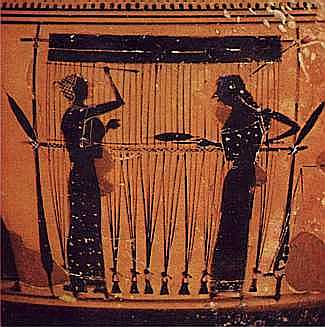
I have often pointed out to my own daughter that in many cultures and times she, at the tender age of 15, would be very seriously looking at becoming or already be a wife in charge of her own home and household.  The funny thing is she doesn’t look at this with horror but more a sort of awe that  a young woman would be expected to manage servants, home production of clothing and food, maintenance of the property, in some cultures the planting and harvesting of crops, perhaps wine making, olive pressing, carding, spinning, and weaving, and the care and education of her children.   I just really don’t get the odd fascination that I find over and over again with the idea that woman were pathetic chattel dominated by oppressive men who wanted to keep them stupid and worthless when history and plain common sense say otherwise. 

attheloom.jpg

I would much rather my children look through history at the beauty and honor of women.  How they have worked their looms, tended their homes and gardens, made good cheese and raised their children.   I defiantly don’t want them too look at woman as historical victims.  Victims are often worthy of pity, but they usually do not inspire respect.